


Twelve score and ten years from the day the colonies signed their civic creed, America is groaning through a crisis of belief.
America, said Spiro Agnew, the vice president of Richard Milhouse Nixon, “is still the greatest nation in the country.” There are wisdoms in this nugget, which Gore Vidal was fond of quoting, that we haven’t even begun to glean. Instead of chalk it up to malapropism, we might do better to inquire what other nations in this country there might be. Ronald Reagan, in his last speech as the free world’s leader, before declining ever deeply into what Mr. Vidal once termed “the springtime of his senescence,” implied the possibilities were limitless:
A man wrote me and said: “You can go to live in France, but you cannot become a Frenchman. You can go to live in Germany or Turkey or Japan, but you cannot become a German, a Turk, or a Japanese. But anyone, from any corner of the Earth, can come to live in America and become an American.”
Yes, the torch of Lady Liberty symbolizes our freedom and represents our heritage, the compact with our parents, our grandparents, and our ancestors. It is that lady who gives us our great and special place in the world.
Americans, more than anyone, love to hear why they are special. And there is nothing specialer, it seems, than being everybody else—
We lead the world because, unique among nations, we draw our people—our strength—from every country and every corner of the world. And by doing so we continuously renew and enrich our nation…. If we ever closed the door to new Americans, our leadership in the world would soon be lost.
This was more than your typical serving of Reaganite schmaltz, with its self-flattery and indulgence and unearned paeans to the brotherhood of man. When Mr. Reagan first toddled into political office—on the campaign pledge to send “the welfare bums back to work”—the United States was still just phasing out the racial immigration quotas meant to keep the country’s average melanin levels low. The civil rights act—which he’d opposed—was less than three years old. But the inkling that everyone on earth was really an aspiring American all along has held a near totemic power in the American psyche. And the notion that anyone who tries can get a piece of that American pie has been an enduring point of national pride. The Swedish economist, Gunnar Myrdal, wrote that the universalist ideals inscribed into the colonists’ letter of independency, about “liberty” and “justice” and “equality” for all, were cherished by Americans like a “creed.” Writing at a time when blacks had separate drinking fountains and naturalization was still limited to mostly whites, Mr. Myrdal had his work cut out for him in documenting this “dilemma” between Yankee practices and preachments.
The semiquincentennial birthday of America has engaged Americans’ taste for numerology and their knack for navel-gazing, inviting many ponderings on their favorite topic, which is themselves. Americans love a good origin story, and there is no story they quite love hearing like their own. What they lack in length of history, they make up in sense of purpose. That the country has a mission statement is its great, abiding charm. The “American creed,” in a different sense, is also a creed about a creed—the belief in the nation as a conscious “project” or “experiment,” founded on certain moral precepts, which Mr. Jefferson and his pals one day signed into scripture and which one joins by a profession of agreement.
Just in time for these festivities, the country’s court of last resort capped off their term this 30th day of June with the delivery of some civic gospel truth. The question of who gets to be American—long thought settled by the constitution and statute books and a century of legal precedent—was being given another look. Knowing minds discovered the constitution had a secret footnote, which no one else had ever noticed; and only Donald Trump, in all his sapience, had the balls to see its doctrine through. Some babies born in America, it turns out, are not American at all. There has to be a little something else. To be born American, America has to be your home—and America is the homeland of Americans! This idea possessed the hearts of those who kneel before the mysteries of the border, and lodged in the minds of three or four of our highest jurists. But the robed majority closed ranks around orthodoxy, and swung down the gavel of dogma, banishing the new doctrine with a timely, feel-good vindication of the all-American creed.
Ketanji Jackson, who joined the court’s majority but wrote separately to score a few choice digs, voiced the credal position best:
[T]he Nation, from its founding, had “boldly proclaim[ed] that all men are born free and equal, and that consequently life, liberty, and the pursuit of happiness, are inherent in every individual, vested inalienably by natural birthright.” No ideal was more inherently American.
The right-wing meltdown over Trump v. Barbara was swift and apoplectic. The danger it invites, we are now told, is existential. The prognosis of the nation’s identity is terminal. The supreme court’s affirmation of birthright citizenship—which says that anyone who’s born here is a member of the citizenry—has induced what might be called a demographic panic. Never mind that this involves a class of persons—children, and more specifically newborn infants—who cannot meaningfully be said to be “from” anywhere else, and whose claim to “belonging” is just as good as any other’s in the maternity ward. (Their only crime is being on the wrong side of a birth canal to warrant sympathy from the right. But it’s precisely in the womb and where that comes from that the trouble arises.) And never mind that birthright citizenship has been in the law books since 1898, and in the constitution since 1868, and that no one now alive has ever known any different. No, no, says Stephen Miller, the white house deputy chief of staff and advisor on “homeland security”:
This is absolutely a deep knife-wound in the heart of the American republic…. We have people from all over the world, from third world nations—nations that on their own would’ve never invented the wheel, let alone modern technology, let alone medicine, let alone air travel—and they can just come into the country, have a baby in a hospital—paid for by you and me—and then that baby’s automatically a citizen?
It’s only the latest fuss in the great white crash-out of the early 21st century. This genre of tantrum, of course, is nothing terribly new. In their satirical book on The American Credo (1920), h.l. Mencken and George Jean Nathan included, among Americans’ cherished ideas, the belief that “all immigrants come to America in search of liberty, and that when they attempt to exercise it they should be immediately sent back.” But for a while this sort of thing had to be more winked-to than said aloud. One salient new feature of the saeculum Americanum, as it draws near its quarter-millennial turn, is that a large and growing segment of the country has openly disavowed what used to be a bipartisan civic religion. The crisis occasioned by this apostasy will not remain a simple matter of faith.
Don’t let’s be partial here: the schisms in the church of Americana are occurring on both sides of the aisle. Neither camp is much enamored with the pieties of last century. For a while, it’s been the habit of more progressive-leaning types to shun the national day of barbecues, with repeated and predictable citations to the great abolitionist statesman Frederick Douglass’s 1852 address, “What to the Slave Is the Fourth of July?” Yeah, yeah, the picnic abstainers tell us. All men are created equal. Nice words, coming from the quill of slavers! The national high holy day of kitsch and self-congratulation only “reveals to [the enslaved], more than all other days in the year, the gross injustice and cruelty to which he is the constant victim.”
You will notice, however, that this critique takes place at the level of the country’s “eternal principles” (his words) themselves. Mr. Douglass was no rejectionist: the speech was given to the Women’s Anti-Slavery League of Rochester, New York, people who already agreed with him, and had invited him to share some rousing words. Douglass was no William Lloyd Garrison, who called the u.s. constitution “a covenant with death, and an agreement with hell.” The constitution was a “glorious liberty document,” according to Frederick Douglass, who enjoined his audience in that same speech to “[s]tand by those principles” in the declaration of independence, “be true to them on all occasions, in all places, against all foes, and at whatever cost.” He was a creed believer through and through, and leveled his objection on America’s own terms.
Mr. Douglass was the prototype of a sort of liberal self-criticism. In 2019, the New York Times followed this tradition in their celebrated and controversial “1619 Project.” The project’s contents, which tell the story of America’s mishandling of a people it once held as chattel, should not be news to anyone whom the education system hadn’t left behind. And Nikole Hannah-Jones, the project’s leading writer, didn’t go so far as to reject the “founding ideals” themselves, but more the fact that they were unmeant at the time. But “black Americans,” she insisted, no less “believed fervently in the American creed.” What plunged conservatives into a tizz about the “1619 Project” was that it identified the nation’s founding with the national hypocrisy. This made America’s story less like the one of a promised land and a chosen people, and more the one about a serpent in a garden.
There was back then to this an outpouring of white hot seething rage, mostly of the semiliterate and ego-bruised variety. Campaigns to ban the project in the schools, or counter it with patriotic fluff, arose in droves to purge the scourge of “woke.” Yet the backlash from the right was still a testament to the creed’s persistent strength, revolted as they were that anyone might dare profane the founders’ names, or think the founding’s legacy anything but pristine.
So it’s the right whose lapse in orthodoxy is more puzzling and amusing. Or it would be, if it weren’t so predictable and foul. Even before the court’s Barbara decision dropped, conservatives were busy with a struggle session of their own. The offender was the supreme court justice Neil Gorsuch, once thought a trusty steward of right-wing prudence and jurisprudence, who’d been speaking to the media like so:
Our nation is not founded on a religion. It’s not based on a common culture even, or heritage. It’s based on those ideas [in the declaration of independence]. We’re a creedal nation.
Doubling down on this to Margaret Hoover on the rebooted Firing Line, Mr. Gorsuch had this to say:
We were never supposed to be a nation that was about one race or one religion. It was about those ideas. That those things are perfect ideas that speak to every human heart and that unite us all…. America is available to each and every one of us.
That this need even to be said in 2026 on broadcast t.v., and by a sitting member of the country’s highest court of law, should give one pause. Neil Gorsuch, in the end, did join the right-wing dissent in Barbara, and toed dependably the m.a.g.a. line on birthright. But from May to June this year he caused his side some serious sweat and palpitations, over the sort of pablum that made Ronald Reagan so beloved. Mr. Gorsuch, it was alleged, had paid insufficient tribute to the glories of “heritage” and “tradition”; had besmirched the faith of the founding fathers; was letting “mindless rhetoric and a naive self-conception” destroy the country with a flood of un-American babies. “America,” to quote a characteristic whine, “is more than just an idea. She is a nation and a people—a nation and a people that generation after generation of Americans and their ancestors, over the course of four centuries, have fought, bled, died, killed, sweat, wept” etc., etc. You got the impression, after all this gasbaggery, of the world’s most tedious sports fan seizing in an epileptic fit when their favorite team is slighted.
The weird blogger Curtis Yarvin, whom some believe a guy worth spending thoughts on, observed on Twitter the “cuck energy” of Neil Gorsuch, whom he imagines feeling “warmth as he gives away your country to South Sudanese bvll” (sic). Real edifying stuff. Since Barbara came down, Mr. Yarvin’s gotten mileage out of his pet take that America’s founding was itself a Marxist conspiracy, that “being a 1776-cuck makes you a 2026-cuck,” and that the constitution “is, indeed, a suicide pact.” No surprises there from the basement-dwelling mutant right, but Mr. Yarvin does have the ear of the vice president, who in a speech last year to the crackpot Claremont Institute set the tone of right-wing bloviation:
If you think about it, identifying America just with agreeing with the principles, let’s say, of the Declaration of Independence, that’s a definition that is way over-inclusive and under-inclusive at the same time. What do I mean by that? Well, first of all, it would include hundreds of millions, maybe billions of foreign citizens who agree with the principles of the Declaration of Independence. Must we admit all of them tomorrow?
If you follow that logic of America as a purely creedal nation, America purely as an idea, that is where it would lead you. But at the same time, that answer would also reject a lot of people that the a.d.l. would label as domestic extremists.
I’m not too amnesiac to remember when it was guys like Marco Rubio and Ted Cruz and Paul Ryan who said the opposite, but I do appreciate dear j.d. revealing his sympathies. Mr. Vance must be workshopping this theme, which he first floated in his v.p. nomination speech, groaning on about the importance of “our homeland.” Speaking of which, the federal agency consecrated to its “security” has caused some stirs these past two years, with public statements repeating “Heritage” and “Homeland” like a mantra. (The two Hs, often capitalized, are almost surely not coincidental, nor is this administration’s penchant for writing posts in 14 words.) Unhelpful to beating the allegations is d.h.s.’s stated aim of doing 100,000,000 deportations—about 1/3 of the total u.s. population—and its gift for gunning down u.s. citizens in the streets. But such is the price of fighting for the homeland, as Jimmy Vance would have it. “Because America,” says he,
is not just an idea. We’re a particular place with a particular people and a particular set of beliefs and way of life. Our ancestors realized that to carve a successful nation from new land meant creating new tangible things. New homes, new towns, new infrastructure to tame a wild continent. That is our heritage as Americans.
There is an irony in conservatives being the ones to ditch the creed, when the credal myth had been so long to their advantage. In his book The Constitutional Bind (2024), my former professor Aziz Rana describes how the creed took on a central role in cold war propaganda, giving legitimacy and cohesion to u.s. empire. To beat the soviets at their own game, the Americans used the creed to make the case for the u.s. system as a universal good, a model to be venerated at home and exported abroad. Thus was Ronald Reagan, no liberal bleeding heart he, able to champion Yanqui universalism and superiority in the same breath. And this, topping off a time in office giving aid and comfort to the murder squads of Pinochet and Marcos and Bermúdez and Ríos Montt, in exchange for their pledging fealty to liberty and justice and foreign capital for all.
What a difference makes the iron curtain’s fall. The new rightists of today, having lost their commie bogeyman, are less sanguine about the need for u.s. imperium. Some of them, like the Longs and Lindberghs of yesteryear, would like to ditch it altogether. You saw a bit of this inchoately in the less seemly corners of the “antiwar” camp in the Bush years, where the poor and howling ay-rabs of the backward middle east were said to be unready for the blessings of democracy. Nowadays, the incompatibility of the swarthier breeds of man with the western way of life isn’t just a bush for tough-minded “realists” to beat around. It is the mental and emotional linchpin of the heritage-first right.
Somehow or another, both the left- and right-wing deviations from credal orthodoxy have looped back to meet at a new point of near-agreement. They agree, as it turns out, that the myth of a liberal founding based on universalism is in some way false; that America, after all, was meant for white people. To the left, the myth was a touching but self-serving story for a country built on slavery and Jim Crow. To the right, the myth was a liberal (or communist, or unitarian, or Jewish, take your pick) imposition of the woke postwar agenda designed to make the great white nation of Christian America feel bad. It isn’t hard to see in this a bit of living down to expectations, as if the right, having heard for years about how racist the country really is, decided, “Yes, you’re totally right. Now get the hell out.”
It bears mentioning that the heritage-humpers do have a creed myth of their own. The practice of forming governments by consent to a set of principles goes back at least to the Mayflower and its compact, as well as the colonial charters that were the original written constitutions. It’s a part of “heritage,” not its opposite. The perennial question is who that creed is for. Is America a country with a creed, or a country that grew out of one?
The long shadow over the heritage right is cast by Samuel Huntington, Harvard’s late great political scientist, who was kept shivering awake at night about Latinos. In 2004, Mr. Huntington answered his own question in the treatise Who Are We?, writing:
The racial and ethnic Americas are no more. Cultural America is under siege. And as the Soviet experience illustrates, ideology is a weak glue to hold together people otherwise lacking racial, ethnic, and cultural sources of community.
“Multiculturalism,” he went on, “is in its essence anti-European civilization…. It is basically an anti-Western ideology.” And it was the western and European “settler culture” (his term) who produced America’s founding principles to begin with, who were uniquely suited to them, and to whom they chiefly applied. Those principles were not for everyone, only those who dreamed them up. “There is no Americano dream,” Mr. Huntington protested. “There is only the American dream created by Anglo-Protestant society.”
It was Lincoln, of course, who made the greatest use of that “Anglo-Protestant” tradition, precisely by letting Mr. Jefferson’s general and universalizing words do all the work. Jefferson, who knew how to wax poetical on the rights derived from “Saxon ancestors,” thought it more fitting in his declaration to leave the ethnic basis out. And so he laid the ground for Lincoln’s famous formulation of America being “a new nation,” not an old one, “conceived in Liberty,” not in slavery, and “dedicated to the proposition that all men are created equal.” It’s to Lincoln’s credit that this interpretation won the day, as well as the civil war. But he was playing rather fast and loose with language. William Buckley’s mentor, Willmoore Kendall, knew this more than most, accusing honest Abe of a “Lincolnian heresy” from the founders’ wishes and of “falsify[ing] the facts of history…in a way that precisely confuses our self-understanding as a people.”
The declaration, in reality, was not intended as a national charter. It was a diplomatic missive, severing ties with England’s George and seeking help from Spanish Carlos and the French Louis. The bit about all humans being equal was a statement of first principle and a plea for recognition: the colonists had a right, just like any other, to form a civil government and assume a “separate and equal station” “among the powers of the earth.” It wasn’t a claim to how a civil government should be run. Even liberty, though it be natural, was not a civil guarantee: though English law acknowledged slavery to be “odious” to the laws of nature, it left the practice valid when enacted by the positive law. And where the positive law was so enacted was the colonies. The principles of the declaration didn’t need to furnish any social relation in particular. And hardly anyone—not even Lincoln—quite imagined blacks and whites living together as free and equal citizens under law.
That didn’t stop the declaration’s critics from suspecting otherwise. In the senatorial race of 1858, Stephen Douglas made much hay of Lincoln’s flair for quoting Mr. Jefferson on “equality,” accusing him of harboring secret designs for race-mixing and black voting. (Lincoln, to his great shame, denied this.) But the constitution, Douglas countered, was “established on a white basis,” whatever Jefferson’s infelicities might suggest; and black people were excluded, being “incapable of self-government.” Even then, the enemies of liberty could smell the declaration’s dangerous potential. Three years later, the vice president of the southern rebels, Alexander Stephens, blamed the crisis on that Jeffersonian spirit of égalité:
Those ideas…were fundamentally wrong. They rested upon the assumption of the equality of races. This was an error….
Our new Government is founded upon exactly the opposite ideas; its foundations are laid, its cornerstone rests, upon the great truth that the negro is not equal to the white man; that slavery, subordination to the superior race, is his natural and moral condition. This, our new Government, is the first, in the history of the world, based upon this great physical, philosophical, and moral truth.
Mr. Stephens was being somewhat presumptuous. At the time of the secession, the supreme court’s ruling in Dred Scott v. Sanford (1857) was still the union’s law. The question presented there before the court was whether Mr. Scott, a slave, had standing as a u.s. citizen to sue for freedom. It was a question rupturing the nation for some time. Could a person be a free citizen in one state and an unfree toiler in another, based on an accident of birthplace? Was he freed by stepping foot across a line? Should the u.s. government dispatch agents to hunt down the border crossers hiding in jurisdictions that gave them sanctuary and deport them back to where they belong? Might a person be living freely, raising their own family, minding their own business, and drop it all when the fugitive catchers come? It was a question that went to the very heart of what it means to be a “citizen.” Roger Taney, the chief justice, hoped to settle it once and finally:
They had for more than a century before been regarded as beings of an inferior order, and altogether unfit to associate with the white race, either in social or political relations; and so far inferior, that they had no rights which the white man was bound to respect...
The general words [in the declaration] would seem to embrace the whole human family, and if they were used in a similar instrument at this day would be so understood. But it is too clear for dispute, that the enslaved African race were not intended to be included, and formed no part of the people who framed and adopted this declaration…
[C]itizenship at that time was perfectly understood to be confined to the white race; and that they alone constituted the sovereignty in the Government.
There’s a good and well-trod argument that Roger Taney was wrong on the legal merits in his Dred Scott decision. And there’s also a good argument he was right. As pointed out by justice Benjamin Curtis in dissent, there were black citizens who cast their ballots to adopt the constitution of 1787, which made them as good a part of “we the people” as anyone else. And yet there could be no denying that the constitution as it was written tolerated their enslavement, and even provided for the right to property of the slavers to be enforced across state lines. You’ll find ample evidence of both stories in the annals of America. Both were baked into the original American pie.
There are, in fact, two separate credal visions of America. Neither one begins in the 1,776th year of the lord on the fourth day of July. The first one is traced by its adherents back to 1620, when the “pilgrim” settlers arrived in what used to be called Patuxet, to found a colony of English puritans called Plymouth. The new catchphrase of this credo is “heritage Americans,” an elastic cheeseball of a term that seems to encompass anyone of a sufficiently caucasian-passing vintage, or whose ancestors arrived at some time prior to an ever-moving cutoff, often placed around 1965. That was when the u.s. congress passed the Hart-Celler act, lifting the near-total bans on immigration from 2/3 of the globe (you can guess which parts), inducing a psychic trauma which the right has never gotten over.
This creed’s adherents speak in ominous tones of birth rates and foreign swindlers and the hopelessness of assimilation. They have an unrelenting fear of being “replaced.” They have a soft spot for old Rhodesia and the plight of white South Africans, in whom they see a grim prediction of their future. They believe the nation is their exclusive inheritance; that membership is a function of parentage or ancestry; that its values and institutions are the products, and thus also the property, of what they call a “culture.” They are the spiritual heirs of the Stephenses and Taneys of days gone-by.
The second creed was born from the age-old debate between Frederick Douglass and William Garrison. Did the u.s. constitution lay the ground for freedom, or was its founding rotten from the start? History answered for them and decided both were right, and the solution it devised was ending slavery. Abolition meant there was no more basis in the law for someone’s ancestry or parentage to matter, like the Dred Scott decision said they did. If you were born a legal subject, you were a citizen. Birthright citizenship didn’t come from the 14th amendment, as commonly believed, but from the 13th one, which was the basis for the civil rights act of 1866. That act affirmed the principle of jus soli two years before the country ratified the 14th. The point of the amendment of 1868 was to remove all legal doubts in the belief that citizenship, regardless of blood, is a function of being free.
This was an extraordinary revision, and even a revolution, to correct what the founding generation never got around to. It brought the “American idea” nearer than before to being more than a free people in a country, but a country of free people. This was never a foregone conclusion, and it didn’t happen overnight. Deportation of the freedmen is what the war’s losers preferred, or else their being kept in a second-class and cheaply hired social station. But if freedom followed the flag, as the victors seemed to think, it put the old hierarchies in jeopardy. The essential task of white reaction, then, was to keep as many people as they could on the other side of freedom’s borders, metaphorically and literally.
The spirit of forgiveness and forgetfulness that pervaded the postwar years conjoined the partisans of both creeds under the same imperial roof, and sometimes on the same pews. The same union that freed the slaves and crushed the rebs went west and massacred the Indians. At the Pacific, the arrival of Asian “coolie” workers made unlikely bedfellows of abolitionists and bigots, who could agree, for their own reasons, on excluding the Chinese. Deeper in the Pacific still, the union planted the old glory in the Philippines, as they’d done in Puerto Rico and in Guam, which gave occasion to revisit the old question of whether equality and self-government were mankind’s birthright after all.
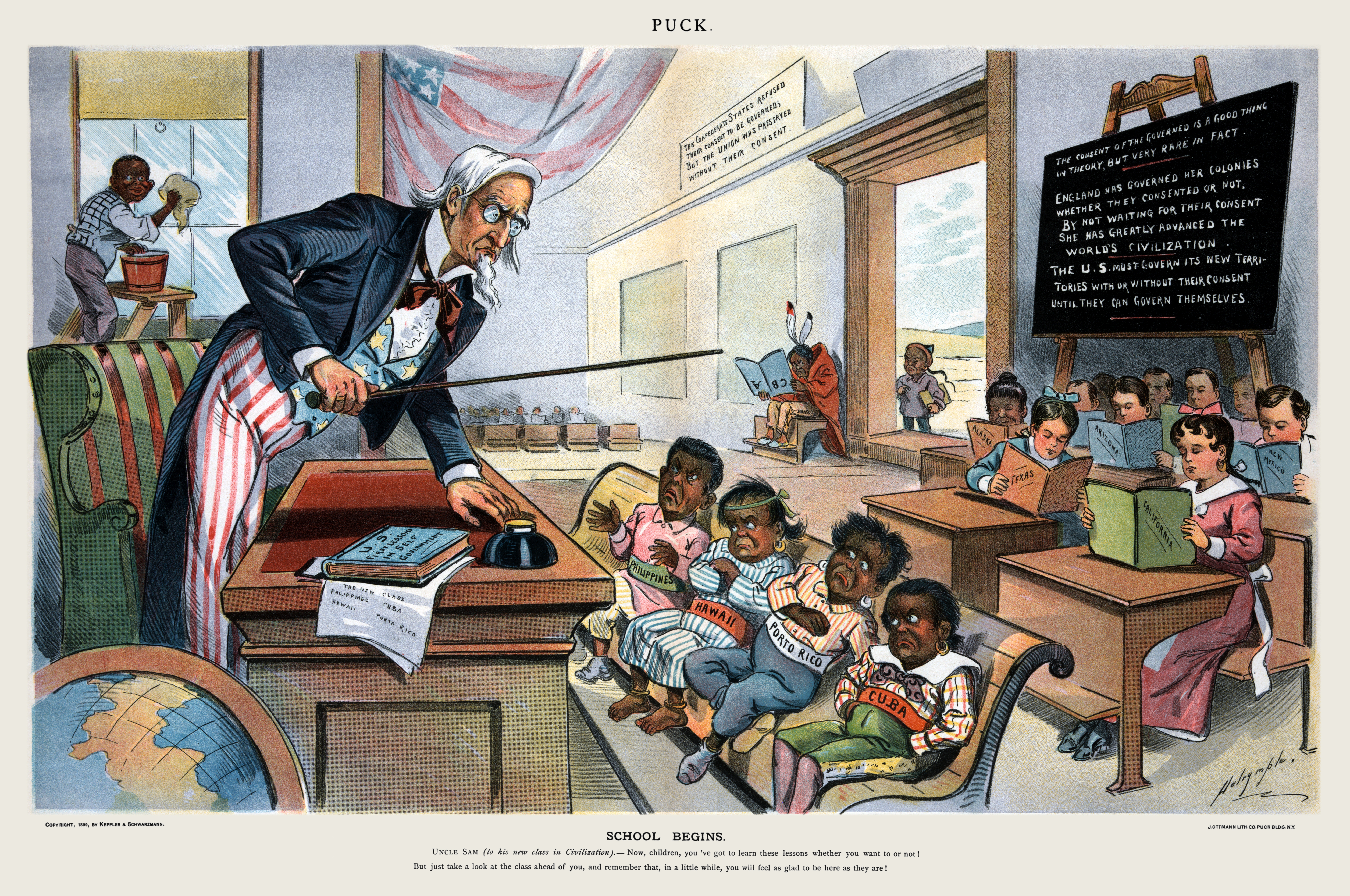
The prospect at the turn of the 20th century of inviting droves of tropical browns into the union, and altering the balance in the congress, proved a bridge too far. At the same time, tío Sam wanted their lands, and could use the help in backbreaking and menial labor which the end of African slavery left vacant. Puerto Ricans were deemed white enough in skin, and small enough in number, to be absorbed into the “English-speaking race,” and on that basis granted u.s. citizenship in 1917. Yet the empire couldn’t countenance “10,000,000 Asiatics becoming American citizens and swarming into this country.” (The statesman William Jennings Bryan, who denounced the sins of Darwin and took lessons on creation from above, warned that Filipinos were “so different from us in race and history that amalgamation is impossible[.]”) A bargain was struck, which gave the Puerto Ricans rights as citizens in the empire but denied self-rule at home, while importing Filipinos as sub-citizen laborers in America till it came time to cut the imperial cord.
It was in fact the u.s.-administered Philippines, more than the Pearl Harbor base near Honolulu, which bore the brunt of Japanese attack in December of 1941. Franklin Roosevelt chose at the last minute in his “day of infamy” speech to downgrade las Pilipinas, and to single out Hawaiʻi, lest people start to think of Filipinos as a part of the “American story.”
It’s the classic trick of divide-and-rule, which depends for it to work on people let into the club being agreeable, if not eager, to shut the door behind them. The black court justice Clarence Thomas knows more than most the importance of the 14th amendment to his people. He also knows that “citizenship” is what distinguishes Haïtian refugees from people like him. In his concurrence to Mullin v. Doe, the recent case allowing Donald Trump to revoke the legal status of hundreds of thousands of Haïtian residents, Mr. Thomas pointed out a crucial fact which no one should ignore. The immigration laws of this country have never feigned to give noncitizens a guarantee of equal legal treatment. Unequal treatment is the immigration system’s entire point. It’s the last remaining sphere this is allowed. If the laws were ever to take seriously and consistently the principle of equality, it would put the whole legal edifice in question. And Mr. Thomas has an interest in that edifice. It is his way of carving out a space for black Americans in the white man’s world. So he guards jealously the privileges of citizenship for him and for his kin, and tough luck to all the rest. One thing you can say is this is wokeness of a sort.
One of the ugliest and most nauseating and undignified developments in my life has been to see vast swaths of the country’s grown-ups devolve to squealing bigots in real time. The government posts sleek videos of random hispanics being chain-ganged onto military aircraft. Kristi Noem, the bane of dogs and landscapers, poses before her captives in the torture dungeons of Nayib Bukele. Stern admonishments from officials, like “leave now” and “you’re going home,” are issued side by side with juvenile memes of cruelty. One wishes one could wonder who exactly gets off to this stuff, but the simple fact is millions of one’s compatriots have brined their brains in self-pity for so long, it’s the only way for them to feel a thrill.
The hatred or fear of immigrants, “legal” or not, explains this only in part. The other crucial part is that it’s a lashing-out against other Americans, and another idea of America. It’s that “other America”—the one of liberality, civil liberties, constitutionalism and universal solidarity—which kept the former one in check. For a while, the cold war’s compromises and concessions made them agreeable; but with those gone, they’re letting loose some decades’ worth of backed-up rage. This is, I think, the rage of impotence, of knowing their side lost, but clawing desperately to one last vengeful shot. If the right-wing glee over the deaths of Renée Good and Alex Pretti didn’t make this clear, then the eagerness with which the “second amendment” camp embraced the country’s being turned into a “papers, please” police state should do the trick. Most people don’t seem to realize the tectonic costs that “mass deportations” would require—not just in dollars, but in social upheaval, wholesale destruction of communities, the size of government, economic structure, one’s relation to the state, and the purpose of communal life. And if they did know this, they wouldn’t care. The federal budget, a working economy, the constitution can go to hell. And that’s only to deal with “the illegals.”
As I began by saying, the birthright citizenship debate concerns infants whose first gulp of air outside a uterus is as American as any baby else’s. The heritage-first crowd seems to forget—they’re birthright citizens, too. Every citizen is who wasn’t born abroad. The bureaucracies of this country presume this, which is why it’s managed to function without a giant, central registry of citizens, and why you’re able to prove your citizenship without a detailed family tree and authenticated proof of legal status going back god-knows-how-long. Most people only need a birth certificate. But these are technicalities. The new watchword on the heritage right, endorsed by the state department and the department of homeland security, is “remigration”: a contribution of neo-nazis to the lexicon of the u.s. policy, referring to the expulsion of all non-whites and immigrants and their children, including citizens. These “paper citizens,” to use another piece of contemporary right-wing jargon, never “belonged here” in the first place. They and all the rest can “go back home.”
Whether any of this is a logistical or political possibility doesn’t matter. The effect of these ideas, and the premises on which they depend, can be already felt. In Los Angeles and New York, recent electoral wins by progressive candidates are being met with dark insinuations about the electorate being made of “unassimilated” u.s. citizens born to foreigners. This defamation, if it weren’t so grotesque, would be cute. Recent arrivals are much likelier than their children to be conservative, which means they grow more liberal the more “assimilated” they become. But the discrediting of elections where non-white voters play a part will be a lasting feature of u.s. politics; and this, no doubt, will also mean the suppression and the targeting of their white “allies,” too. White liberals and leftists are, in fact, the special object of right-wing vitriol. Thus has Elon Musk—of Canadian and South African extraction, if it matters—been going off these past few days with a new slogan: “Deal with traitors first, then invaders.”
(In William Pierce’s psychotic racial snuff novel The Turner Diaries (1978), which inspired the Oklahoma City bombing and is something of a bible on the mutant right, the global holocaust of non-white races gets to a running start with the famous “day of the rope”—the mass lynching of all “race traitors” in the l.a. metropolitan area.)
Believe the thing or not, “America” has long hitched her identity to the ideals of universalism which the heritage mourners spurn. It’s not unfair to wonder what it is about “American culture” they’re trying to preserve. The writer C. Jay Engel, a miserable toad who has been credited with spreading the “heritage American” term, clues us in:
We must embrace Deportation Culture, we must be known to our grandchildren as the Deportation Generation. Deportationism must become part of our very way of life, our national soul.
There is in white America a deep impression of being fleeced. Some past slip-up—whether dated back to 1965, or 1865, or even 1776—has left them at the mercy of a conspiracy of woke. The slaves were freed and classrooms mixed and foreigners invited in, all from the western man’s benevolence and a sense of noblesse oblige. Then the ingrates pulled a fast one on him, seducing him with “guilt” and “empathy,” leaving him no choice now but to cut the crap and rein ’em in. The end of birthright citizenship, the crowning jewel of reconstruction, would’ve been their consummate prize. They won’t rest content with letting the court have the last word.
There’s a left-wing version of this story, too. It says the principles and values of western liberalism, the constitution and democracy are a ruse, a fig leaf for oppression, lipstick on the Yankee pig. There’s a truth to this that any sober-minded look at history will divulge, and it’s a corrective to the corniness and kitsch of the nation’s unearned pride. But what the cynical reading overlooks is this. The history of America isn’t one of an all-powerful, singleminded monolith of tyranny going back to the founders and the pilgrims. It’s also the story of resistance to it. And through war and revolution and the centuries of struggle, the masses made demands on power and seared their mark indelibly in the story of a country in a struggle with itself. One shouldn’t give the rulers so much credit.
New York, 2026.

