


For decades, the Christian right cried doomsday and warned us all of the impending rapture. With greater access to the white house in a country more divided than before, they aren’t talking about disappearing any time soon.
Prologue to Armageddon
In the end there was neither bang nor whimper, but just the shrugs of the embarrassed and the relieved. People tend to forget about it now, but for some years on either side of y2k, the end of all things being imminent seemed like an actual possibility. To top things off, a genuine sign and wonder: millions of Americans were reading. The pulp novelist Jerry Jenkins and his ventriloquist, “prophecy expert” Timothy LaHaye, invited doomsday-curious readers to imagine a thrilling hypothetical. What would happen if all the born-agains and bible-thumpers and connoisseurs of fire and brimstone, who never stop belaboring how one day they’ll vanish in a rapture from the earth, suddenly, in an instant, follow through with it?
When it happens, the Left Behind book series tells us, you’ll be sorry. Possession of a bible will be illegal. The god-botherers, if any be, will be hunted down for sport. A popular world leader will bring peace to the middle east and unify the nations (this part, remember, is a bad thing) and streamline commerce with a universal currency (even worse). Lest there be any confusion, famines and diseases and sundry disasters, man-made or otherwise, will be visited on the globe, culminating in a giant, epic bloodbath—or really, a deluge, “blood pooling in great masses,” “entrails gushed to the desert floor,” a great big slurry of gore and carnage valley-wide and meters high—in a cataclysmic war between the damned and the redeemed. And only then will Christ descend to rule his faithful happily ever after. Or, more precisely, for exactly 1,000 years, at the end of which the devil gets another go to muck things up on planet earth before the whole thing burns in holy fire.
Time was, you couldn’t walk into a bookstore stateside without seeing a whole section of this stuff. At the turn of the millennium, Americans dreamed of kingdom come. What made the Left Behind apocalypse snuff thrillers (and multimedia franchise) so irresistible back then was that they dramatized, in airport fiction form, a doomsday prophecy millions felt already was underway. A guy could hardly pray in school or buy a gun without some liberal picknose raising taxes. The secularists and globalists and terrorists were closing in upon the persecuted few. The world was headed to the devil; these parts didn’t need any suspending disbelief. According to a poll by Time and c.n.n. in 2002, more than half of all Americans believed the hallucinatory and mystical visions in John the seer’s Revelation, the last book of the Christian bible, were an accurate prediction of the future. The LaHaye-Jenkins duo gave form to this feeling, and in positing a moment when billions of the born-again will be whisked up bodily into the heavens, the authors pointed to an escape:
We really do have some powerful reasons for supposing that our generation has more reason than any before us to believe [Jesus] could come in our lifetime!
That was them in 1999, in the foreword to their “non-fiction” companion book, Are We Living in the End Times? (a question whose answer might be furnished in the fact it had to be republished, and updated, in 2011). Mr. LaHaye, who passed in 2016, wouldn’t get to prove his critics wrong before the good lord called him individually above. Yet he did get to bear witness to an eventful time indeed. There were riots in Los Angeles in 1992. Federal agents gunned down a patriot’s wife and kid at Ruby Ridge, and torched a compound of the prayerful in Waco. In revenge, two enterprising white supremos blew up an Oklahoma federal building. Later that year—in 1995, the same year the Israelis signed the second Oslo with the p.l.o.—the first installment of the Left Behind books hit the shelves. The millennium bug and the hijackings on the 11th of September came near the midpoint of the series’ run. War came to Iraq, site of the biblically significant Babylon, to depose Saddam Hussein. One year after the last book’s publication, the country picked a president called Barack Hussein Obama.
It’s quaint in hindsight now, but there was a lot of talk back then of Mr. Obama being a likely candidate for the “antichrist,” the so-called “beast” of Revelation, an apocalyptic dictator who rules the earth in the last days. The standard right-wing media diet in those years of “tea party” theatrics gave relish to the thought that the country was heading somewhere between Nineteen Eighty-Four and the first half of Atlas Shrugged, all foretold in the Revelation of St. John. Invocation of end-times prophecy and conspiracy entered the mainstream of conservative vernacular, and washed the partisan heat in Washington with an apocalyptic glow. The general tone was plaintive, alarmist and downright pessimistic. By 2010, 59% of white evangelicals believed Jesus would come down within a generation. Things were getting so bad down here only the hand of providence could bail them out.
And then—poof. All that rapture business seemed to evaporate from the news cycle, some time after the back-to-back failed predictions, in 2011, by the radiovangelist Harold Camping. Talk of the end did stay a fixture of pop culture (the novelist Tom Perrotta’s secular take on the rapture premise, The Leftovers, was adapted to a successful h.b.o. show in 2014). But between global climate disaster and the election of Donald John Trump, doomsday rhetoric in public was almost a liberal fixation. It wasn’t till last autumn that the rapture idea breached containment from its usual fundamentalist circles, when Joshua Mhlakela, a guy in South Africa who styles himself a preacher, broke out of Christian TikTok with his viral calculation of when believers should expect the last and best vacation of their lives.
But apart from a few good chuckles to be had at the expense of doomsday-ready influencers, the non-event of “RaptureTok,” on Mr. Mhlakela’s predicted date of September 23, 2025, went by relatively unremarked. Something else that week was titillating the pious and the devout. Two days prior, scores of thousands of believers (with maybe millions more in overflow and tuning dutifully in from home) had just gathered in Glendale’s State Farm Stadium, home field of the Arizona Cardinals, to fill the stands with moist effusions of religious mania. Fluffed up by a lower billing of worship music chart-toppers, then led through foreplay by celebrity apologists and politicians, the participants went round after round in schmaltz and spectacle, edging through a patriotic liturgy, into a climax induced by Donald Trump himself. There were tears, during and after. Some awkward gropes and much hot air. Yet the mood of the occasion, though self-pitying, was not exactly somber. The Charles Kirk memorial service and variety show didn’t have the vibe of people expecting to be spirited off somewhere some time soon.
“While Charlie has been reunited with his creator in heaven,” said the president of the United States, “his voice on earth will echo through the generations, and his name will live forever in the eternal chronicle of America’s greatest patriots.” Stephen Miller, an ethnic Jew, put aside any christological hangups in a spirit of interreligious demagoguery: “The light will defeat the dark. We will prevail over the forces of wickedness and evil…. We built the world that we inhabit now, generation by generation. And we will defend this world.” The theme of saving western civilization was much-rehearsed, including by the Roman catholics James Donald Vance and Marco Rubio. Tucker Carlson, an episcopalian, was similarly sanguine: “As we proceed into whatever comes next—and clearly something’s coming next—remember this moment. Remember being in a room with the holy spirit humming like a tuning fork. This is the way right here.” But Jack Posobiec, the catholic extremist and pizza cognoscente, put it best: “I say to you that a century from now…they will write that the sacrifice of Charles James Kirk was the turning point…. Our civilization will endure. The United States of America will endure….
The bible tells us that on his last day, Moses climbed to the top of the mountain and he looked across the river Jordan and he saw the promised land. He led the people there, but he did not cross himself…. On his last day, Charlie Kirk was on the top of a mountain and Charlie Kirk led us there and Charlie Kirk has brought us to the promised land.
The following day, in a video circulating on the digital klansmen platform formerly known as Twitter, the right-wing influencer and serial plagiarist Benny Johnson was positively glowing: “If you watched online yesterday, or if you were physically there…you were part of Christendom history. The advancement of the kingdom—the single, arguably, largest advancement of the kingdom of Christ happened yesterday, live, and we were all witness to it…”
The Gospel According to M.a.g.a.
The Kirkchella prayer-propaganda extravaganza of September 2025 was something like a state funeral, a red carpet gala, and a political campaign rally rolled into one. It was also a soft launch party for America’s new official state religion. The gospel according to m.a.g.a. is housed in a football stadium, naturally, and its visual scheme is the patriotic, hyper-saturated Fox news hues. Its aesthetic is the megachurch; its liturgical tongue, youth pastor standard English. Its apostolic line runs down a roster of manosphere shock jocks, social media toads, natural supplements dealers, incel whisperers and government officials. Its premier intercessor is the patron saint of lonely college virgins and young Republican dropouts, the martyr who was less a pundit than a prophet, Charlie Kirk.
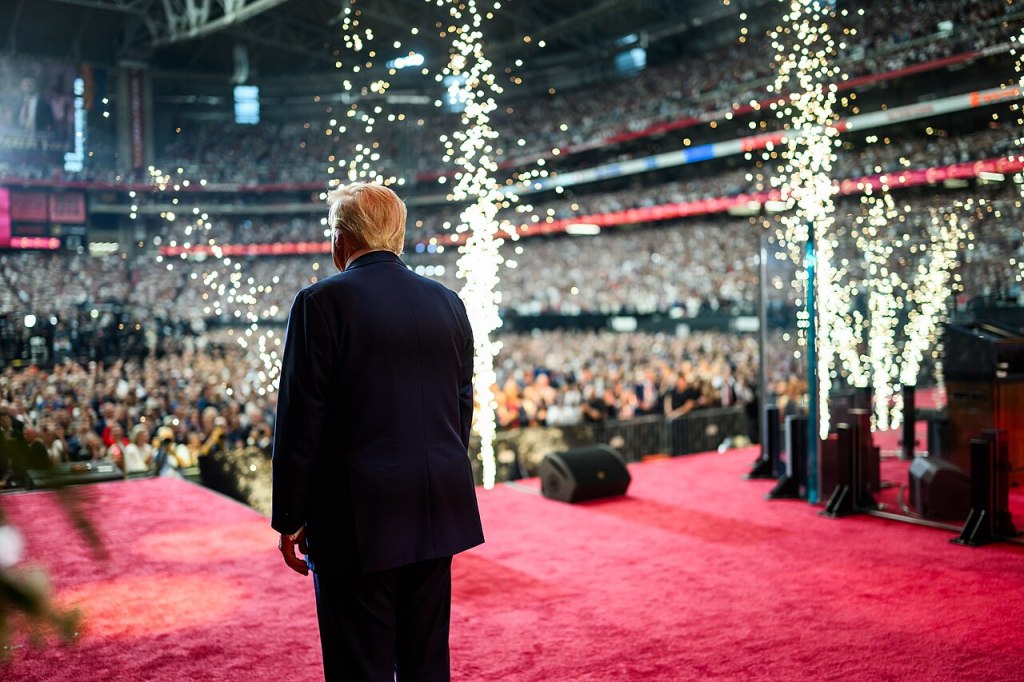
There was something jarring in the way that Mr. Kirk, who’d made a career of scoring jabs on flustered teens in the culture war, was being canonized as the nation’s spiritual shepherd. Speaking to the u.s. house of representatives on the day after Kirk’s death, Robert Onder (r-mo) compared Charlie to Socrates and John the baptist, as a “martyr for the truth” who “died for Christ,” a statement that is forever part of the congressional record. Mr. Kirk, you may recall, had been delivered to his maker in the middle of a public tirade against trans people and urban crime. The identification of the political with the spiritual tells you much about the state of American Christianity. It also says quite a lot about our politics. Something here is new, if only in its spirit. And ever since the spirit poured upon the faithful on the feast day of saint Charlie, the right has been embroiled in an internecine feud to figure out what that spirit means.
Signs of friction were visible early on, but reached a head last December, when the “America Festival” sponsored by t.p.u.s.a., Mr. Kirk’s organization, saw the Charlie bubble burst into competing factions. All sides claim the mantle of Kirk’s legacy, citing various anecdotes and sayings attributed to their prophet in a manner that clues one in to how the early ummah fractured into different schools of the hadith. Since last December, through the bungling of the Epstein files and the fiasco in Iran, their divisions are only growing more acute. They have also fractured, in ways that seemed two years ago unthinkable, over the question of America’s support to Israel. Yet dissension of these sorts isn’t entirely unexpected. The motley assortment of die-hard protestants and catholics, Mormons and Jews, even the occasional Muslim and Hindu that made up the m.a.g.a. coalition was never particularly coherent. Nor was Mr. Kirk especially well-liked. In fact, his utility as a unifier—more than from any specific opinion he espoused or relationship he fostered—came mainly from the fact that his death vindicates the persecution complex that is the conservative’s stock in trade. In life, Charlie’s contribution was to take that toxic grievance stew and serve it with a generous side of smugness and belligerence. The grievances themselves are neither novel nor unique. What’s new here is the attitude, and it’s what he shared with all now who claim his legacy: the attitude of identifying with power.
It used to be a Democrat could hardly sneeze without the Christian right convulsing in a panic about the antichrist and the new world order tyranny. Any slight enlargement of the government, any small encroachment on private life, were taken as the signs to spurn the world and flee into the hills. When the “Jade Helm 15” exercise went public, alerting citizens that the u.s. military was training stateside, it caused a conservative freakout well beyond the gun trade show and tinfoil hat communities. A solid third of Republicans believed Mr. Obama was plotting the military takeover of Texas. Next thing you knew there’d be the f.e.m.a. camps and microchips and a digital mark of the beast. Paranoia like this made the religious right politically intractable, but it also made them reliably allergic to certain types of government overreach and ever-watchful of authority. But at the Charlie Kirk memorial pep rally in September, Benny Johnson took the stage to damp applause and sang a very different ditty:
In the audience right now, there are rulers of our land. Represented right here is the state department, the department of war, the department of justice, the chief executive. God has instituted them. God has given them power over our nation and our land.…
May we pray that our rulers here, rightfully instituted and given power by our god, wield the sword for the terror of evil men in our nation in Charlie’s memory.
The reference here is Paul of Tarsus, apostle to the gentiles, from whose letter to the Romans comes that famous dictum underwriting the divine right of kings: “the powers that be are ordained of God. Whosoever therefore resisteth the power, resisteth the ordinance of God.” Among those powers that be is the Fox news gasbag Peter Hegseth, now the secretary of the totally christlike-sounding “war department,” a man obsessed with the word “lethality” and the testosterone level of the troops, who can’t seem to keep the shakes down without bombing a country or massacring fishermen. Petey’s holy war lust has inspired quite a bit of buyer’s remorse among the right-wing faction less enamored with foreign entanglements. But where the bickering sides agree is when the war is brought back here. You would think the u.s. government deploying troops on u.s. soil, along with masked agents of the state dragging people from their beds and arresting students for op-eds and shooting citizens on the streets for the stated purpose of culling the country’s population by a third, would arouse some stalwart Christian vigilance. And you’d be wrong.
Mr. Hegseth, it so happens, is a parishioner of the far-right c.r.e.c., the Communion (formerly “confederation”) of Reformed Evangelical Churches, headed by the pentagon’s featured worship leader, Douglas Wilson. Mr. Wilson, who supports repealing women’s suffrage and co-wrote a book defending southern slavery, drummed up some heat recently with his remarks that in his ideal version of America, processions by Roman catholics would be prohibited in public, and supporters of Zohran Mamdani should lose their citizenship. But papists and social democrats need not be too freaked: this future, Dougie assures us, is still some centuries away. Christendom, says he, is still in its “early” years. There is no imminent rapture or day of reckoning in Doug Wilson’s eschatology; the c.r.e.c. is in it for the long haul, at the far-off end of which they can expect the full-scale domination of (protestant and fundamentalist) Christian values in this world, not just the next. In 2022, Wilson’s publishing outlet, Canon Press, released The Case for Christian Nationalism by the political scientist Stephen Wolfe, who calls for the promotion of the “right” religion and the suppression of the “wrong” ones in a country ruled by a “theocratic Caesar.” (Mr. Wilson, it should be said, is considered something of a milquetoast moderate and sellout by the younger batch of ultra-calvinists he’s helped to groom. The schism turned initially on whether the elder Mr. Wilson, who calls himself a “paleo-Confederate,” is racist enough.)
As for Donald Trump—a man who doesn’t look to’ve ever cracked a spine of scripture, and seems to know that when he dies he’s going elsewhere than the pearly gates—the bible-thump brigade seems awfully lenient. Nowadays, there’s very little of your grandpa’s fire and brimstone, with its traditional dourness and judgment and despair of worldly power. With greater access to the Lincoln bedroom than ever before they had, the Christian right’s enjoying the new digs. They’ve taken up the in-house style of crassness and machismo, saying things like “wokeness” is a heresy, “empathy” is sin, and universalism is “civilizational suicide.” They have by turns embraced, indulged or made excuses for the label “Christian nationalism,” and plot openly to put the country, if not the earth, under their “dominion.” They split hairs over the difference between “ethnic preference” (good, holy) and “ethnic partiality” (bad, they guess), but at any rate think multiculturalism is ungodly. They puff their chest with slogans like “mass deportation is the loving, moderate position.” They’re floating the need for a homegrown Augusto Pinochet or Francisco Franco. (Sometimes, they search for models more German in origin.)

Mr. Trump, for his part, has turned the oval office into an organ of religious sponsorship and propaganda, and surrounds himself with those who take directives from on high. He has delegated the task of making policy agendas to the Heritage Foundation. His official spiritual advisor, Paula White, is a holy roller of the prosperity gospel persuasion, who sells $1,000 guardian angels by infomercial and believes her god has chosen Trump for “spiritual warfare” against demons. It’s unclear how much of this supernatural commission Donald knows about, let alone subscribes to. That didn’t keep Charlie Kirk in 2020 from telling the crowd at c.p.a.c., “Finally, we have a president that understands the seven mountains of cultural influence.”
One may well doubt that Mr. Trump would catch the reference, which comes down from John of Patmos: the enigmatic “whore of Babylon,” the scarlet woman of the apocalypse, who sits on seven mountains drunk on martyrs’ blood. To Revelation’s intended audience, the image called to mind the seven hills of Rome, and signified the wicked powers of the earth, on whom judgment must one day come. But in the pentecostal circles Mr. Kirk took the motif from, the mountains have transmogrified into a blueprint for global domination. They are the areas of modern life—family, education, business, media, entertainment, religion and the government—which are believed to be possessed by demons. The deity, in his grace, has blessed believers with a mandate to do battle with the spirits and retake the territories for Jesus. The “seven mountains mandate” is something of a rallying cry for the tongue-speaking contingent, who pledge “allegiance first and foremost to the kingdom of God,” and vow to “permanently control positions of influence and leadership.” One of their more prominent leaders is the televangelist Lance Wallnau, who believes that Kamala Harris wielded occult powers of witchcraft in her debates with Donald Trump, and spreads the good news of the prince of peace in books with charming titles like Invading Babylon (2013).
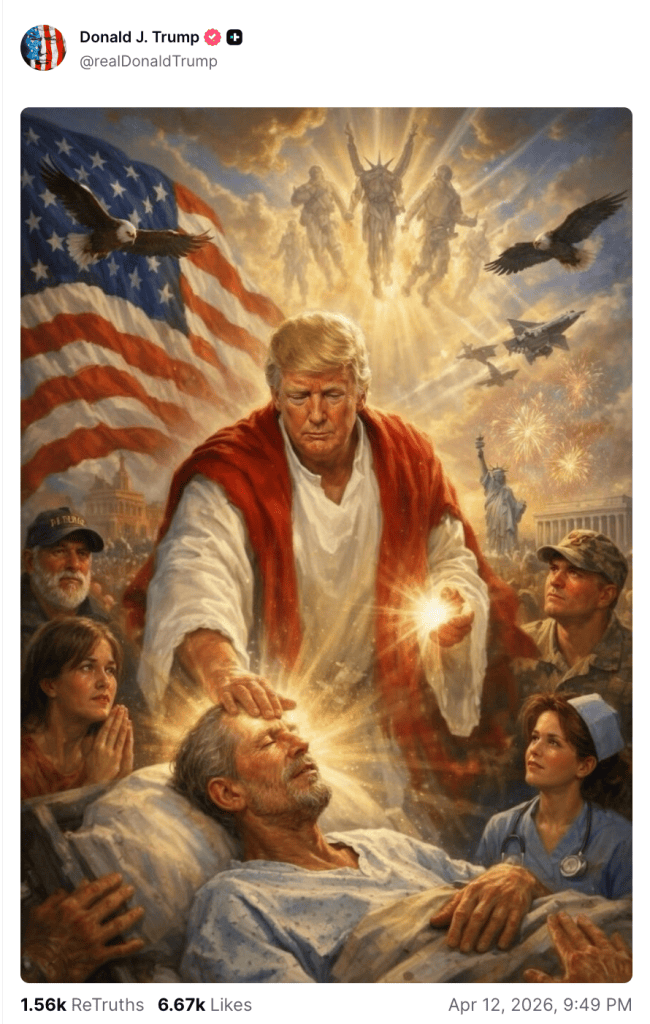
The gardened city of Mesopotamia has suffered quite a hit to her reputation over the years, being remembered in the bible for obliterating Jerusalem and exiling the Jews, and serving as a symbol for idolatry. In Left Behind, a refurbished Babylon, Iraq is chosen as the site of the capital city of the antichrist. She’s the one doing the invading, as it were. But Mr. Wallnau is a guy who has a knack for curious twists on biblical motifs. He has called the u.s. president “an actual old testament prophet-king.” He has proclaimed the whisperings of the spirit telling him that Trump is a new king Cyrus, the ancient Achaemenid emperor who, the legend goes, conquered Babylon and freed the Jews and helped them build a temple on Mount Zion. “Donald Trump,” says Mr. Wallnau, “has an anointing upon him.” Half-demented, bloated finger on the button, one bad cheeseburger away from nuclear armageddon, king Donald is the Christian right’s victorious messiah.
The Millennial Bug
Not to put too sectarian a point on it, the United States isn’t the only place where the cult of Donald Trump has any purchase. Far beyond our shining oceans, between a different sea and another river, the president’s face appears in profile on a special coin superimposed on the face of Cyrus, both “messiahs” being honored for their part in making Jerusalem Jewish again. The collectible mint, a fundraising initiative by Israeli groups that seek to build a Jewish temple on the ruins of al-Aqsa, is only a token of the decades-long affinity between Yankee Jesus-lovers and Jewish zionists, who after all agree (mutatis mutandis) that Jerusalem in the end must house the throne of a coming king of the Jews.
Since at least the 1970s, the u.s.-Israeli “special relationship” had been undergirded by two remarkable beliefs held by vast swaths of American voters: (1) that the the world will soon be ending, and (2) that they will never die. More specifically, the end-times scenario they believed in was a form of divine payback: that Jesus will come down in the flesh to right all wrongs and beat the devil and rule the earth for a millennium, a process that might start at any time. The ingathering of the Jews in Palestine was an essential aspect of this prophecy, which entailed a passionate devotion to the success of zionism. No regional escalation or catastrophe or geopolitical crisis in aid of Israel was too costly, when the payoff is the cosmic will of the divine. And instability and brinksmanship didn’t matter much when they expected to be spared the worst of it—snatched up directly to the heavens in the rapture.
Ten years ago, a survey of u.s. protestants found that nearly half of pastors preached this in some version or another. But the American fixation on the end of things goes back to the beginning. Cristóbal Colón sailed the blue in 1492 with dreams of apocalyptic grandeur, hoping that the riches plundered from the west might give his patron monarchs funds to send him east, on one last crusade to claim Jerusalem before the second coming. What drove Columbus forward was a kind of “millennialism,” or chiliasm (from the Greek word chilioi, for a “thousand”), a belief which goes back to the more excitable and subversive years of early Christianity, when it was thought an age of peace and bliss on earth would dawn when Christ comes back to free Jerusalem and have revenge on Rome. By the time when Rome established Christianity as her official state religion, the wish for Armageddon lost much of its charm, and the literal-minded chiliastics were derided for their “Jewish” superstition. It was easier for Augustinus of Hippo (354–430), a wealthy bishop in the first century of imperial Christendom, to think the millennium had already arrived. Men like him, after all, were the ones in charge.
Rome herself, having been sacked, wasn’t quite the promised kingdom; the “city of god,” to Augustinus, was a spiritual reality, its reign an allegory for the church. Yet wish for a deliverance that was more than metaphorical would resurface in times of crisis or confrontation—the crusades, the reconquista, the wars that followed the reformation—which seemed as good a time as any for the redeemer to cash in his long-awaited rain check.
The discovery by Christian Europe of a whole new hemisphere posed a different conundrum: how to reconcile old cosmologies with the new. Columbus thought he’d landed somewhere near the doorstep of Eden; others thought it was the land of Gog and Magog, the final enemies of Christ in the last days, and America was therefore the abode of Satan. The English settlers of North America had the benefit of distance from the old world, where the antichrist (likely the sultan, or the pope) held sway, and faced the task of creating a society, instead of wishing one away. (To a harrowing degree, the depopulation of the natives, a real apocalypse in itself, did the clearing for them.) Empire-building didn’t lend itself to thoughts of impending doom, but to the dreams of a promised land and beginning the world anew. The can-do spirit was captured and propounded by the preacher Jonathan Edwards (1703–58), who felt in the pulse of religious mania throbbing through New England’s colonies the start of something bigger:
There shall then be a universal peace and a good understanding among the nations of the world, instead of such confusion, wars and blood shed, as have hitherto been from one age to another…. Then shall all the world be united in one amiable society. All nations, in all parts of the world, on every side of the globe, shall then be knit together in sweet harmony.
The views of Jonathan Edwards reflected an empire at its most confident and ambitious. The “millennium,” he believed, could be realized in this world, with the triumph of a truly global Christendom. Christ himself would come back afterward—a “postmillennial” second coming—in a coda to close out history, but only after the church reached “its most glorious state” to cover every inch of earth. And North America, naturally, would be the epicenter of this glorious unfolding, doing the father’s will on earth as it is above. That Edwardsian spirit of optimism and exceptionalism underpinned the rhetoric of “manifest destiny” and the “civilizing mission.” It conjoined old-fashioned Christian moralism with social engagement, spurring on the movements against bonded labor and the bottle. It gave legitimacy to “the white man’s burden,” but also to the doctrines of the “social gospel” and the civil rights reformers. It left its print as much on the wars against the Indians as on the struggle against Jim Crow.
This was a vision of apocalypse suited to an American mentality, which always seems to think itself on history’s winning side. Those who felt like history’s losers made a very different eschatology, which found expression, quite impressively, on the Anglo side in British-governed Ireland. There it was that a clergyman named John Nelson Darby (1800–82) grew jaded by the entanglements of state and church (not least because the state was granting immunities to catholics) and set his sights on things more otherworldly. Then Mr. Darby one day fell off his horse and spent his convalescence dreaming of the Jews. There was a problem, Darby realized, in most Christian theologies: if the deity of the old testament was the same one in the new, he wouldn’t be the kind to go back on his word. The good lord’s promise to the Jews of a new kingdom in Jerusalem was therefore literal and unrevoked. It was the Jews who’d get to reap millennial harvests in the promised land of their messiah; but first there’d have to be some end-times sowing. The Babylonian captivity never really ended; the evil empire just rebranded. Jesus came to free his people, but then the Jews rejected him—and all of history has been one long parenthesis since then. One day that pause will end, and everything will go south. The civil leader of a new Babylon, the “beast,” will unite the nations in a single wicked government; his deputy, a false prophet, will trick the masses with signs and wonders, exalting man above the god; and both will tyrannize the world through years of tribulation and disaster with a blood-drenched climax at Armageddon, when Jesus comes to inaugurate the chiliad. (In this somewhat inelegant timeline of prophecy, Satan is let loose again at the millennium’s end and joins with Gog and Magog for an apocalyptic rematch.) The gentile born-agains, duly rinsed in the lamb’s blood, would get to watch all this unfolding at a safe distance in the heavens, being raptured off, body and all, before things get too dicey.
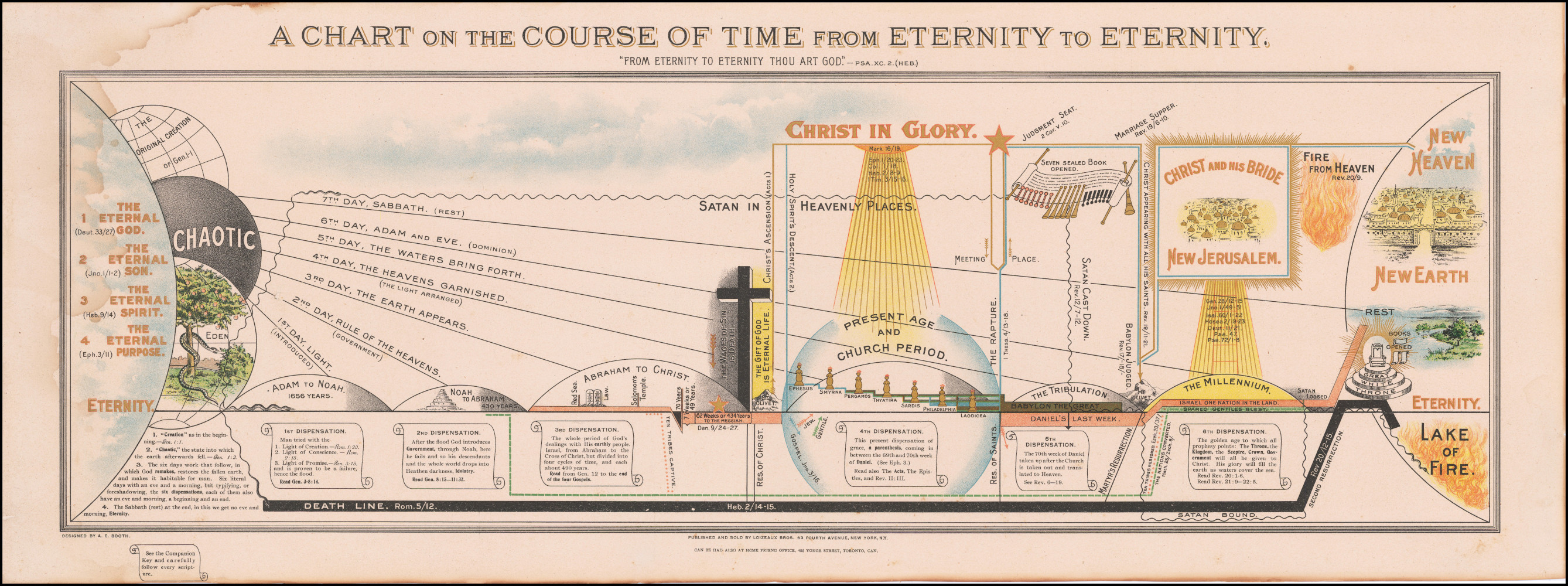
The preachments of John Darby—the version of Christian apocalypse most living Americans have heard of—came to be known as dispensationalism, from the notion that the will of god works differently through time. The dispensation we inhabit is a cosmic interlude before a splendid resolution, but first things have to get a whole lot worse. These ideas gained a stateside following in the years after the u.s. civil war, and they appealed to those who couldn’t jibe with Edwards’s view that history was progressing; who believed, instead, the modern world was in decline. One such pessimist was Cyrus Scofield (1843–1921), an ex-confederate and a conman and a follower of John Darby, whose annotations to the bible, first published in 1909, went on to be a fundamentalist household staple.
How did the doom and gloom of Darby-Scofield come to replace the optimism that defined an earlier batch of Yankee apocalyptics? A lead is given by the c.r.e.c.’s Doug Wilson, an uncommon longtime dissenter from the dispensational consensus, who once appeared on Charlie Kirk’s program to denigrate the “rapture” fad as something like religion’s Vietnam syndrome:
It’s like, this world is God’s Vietnam, and then there’s gonna be a rapture where God helicopters a few people out of Saigon, and then the whole thing falls apart.
It was in fact during the years of “Vietnamization” that rapture mania reached a point of cultural inflection. The withdrawal from Indochina was only the most lurid and embarrassing capstone to a decade of western subversions and humiliations. The youth were getting uppity and sex becoming looser. Prayer was booted from the schools while black students were bused inside. The one-two punch of civil rights (1964) and immigration (’65) legislation showed the gains of the third world, in demanding equal footing with their imperial former masters, were not to go unfelt in the first. The troops came home to find that what they’d tried to root out in the jungle was sprouting just beneath their noses, right on their own lawns.
There were some who viewed such changes in society as signs of progress and enlightenment; to those who saw instead the omens of the devil, the thirst for Armageddon was unquenchable. But whet the need they did in the apocalyptic 70s, as fundamentalist ideas entered the mainstream. The Christian horror flick A Thief in the Night (1973) introduced the rapture scare to a popular mass audience. The racist fortune-teller Hal Lindsey scored himself a national bestseller (and a movie adaptation narrated by Orson Welles) in The Late Great Planet Earth (1970), enticing spooked suburbanites with its prediction that the day of the lord might fall by 1988. And Mr. Lindsey contrived that fateful date from the assumption that the rapture had to come within a generation from the establishment of Israel—whose dramatic victories against the Arabs, in seizing Jerusalem for the Jews, seemed loaded with prophetic possibilities.
It was all too easy for reactionaries, in those startled and bewildered years of midcentury anxiety, to see in Israel the dispensational theory’s clinching proof. And it gave embattled culture warriors, amid the mounting reasons for despair, a divine airlift to look forward to. The worse things got the truer it appeared. That Israel in particular faced increasing criticism in the court of world opinion seemed only to vindicate the point. “No one,” says a character in the first Left Behind movie rendition (2000), “has more enemies who want to see her destroyed than Israel.” He gives the line near the beginning, as the movie opens to a scene of Arab warplanes raining hell on Israel for no reason in particular, before a last-minute helping from the hand of the almighty crushes the invaders in the air. A toothsome consolation for those whose sense of divine favor is matched only by a sense of persecution. What distinguished the dispensational, “premillennialist” outlook of last century’s fundamentalists was its self-pity and defeatism. The world was lost and getting loster, the devil was in charge, and the best that one could hope for was to nab seats on the life raft before the sinking ship got sunk.
Brass on a Sinking Ship
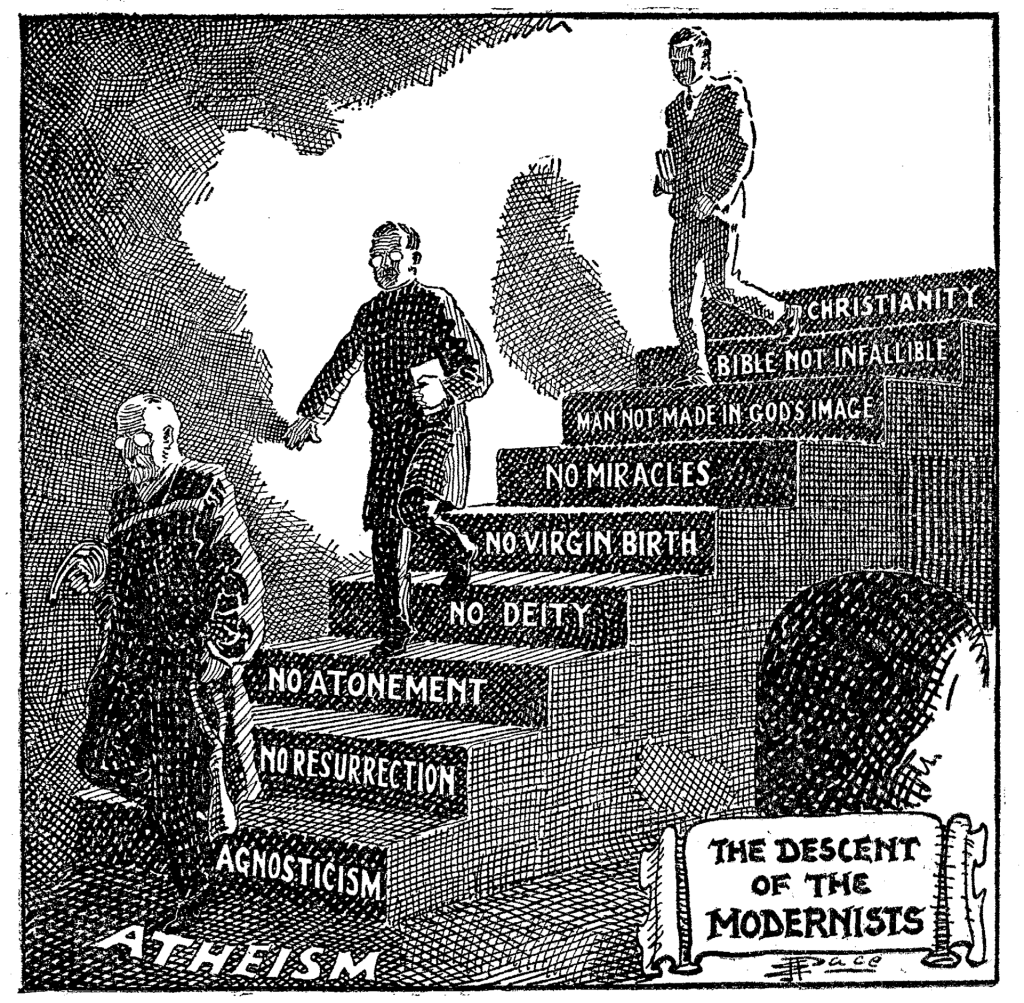
It’s strange to think of now, but there was a time when the u.s. partisans of political Christianity were associated with liberals. What we call “fundamentalists” were in fact schismatics, splitter groups who spurned the “modernists” who ran the churches and the seminaries at the turn of the 20th century, when the temptations of Darwin and Wellhausen were en vogue. Gains in literacy and science were lifting people out of backwardness and superstition, and making headway against poverty and disease. The defeat of slavery in living memory inspired feelings that a better world was possible, that evil could be overcome, and as hoped by Edward Beecher—brother of the more famous Harriet—the lord had “opened the way for the redemption and sanctification of our whole social system.” This millennial task was taken up by the adherents of the “social gospel,” who cared more about the bible’s lessons than its literality. The point of Christianity, as given by the great theologian Walter Rauschenbusch in 1907, was preeminently social, and even socialistic: “to transform human society into the kingdom of God.”
Both sides in the civil war believed their cause was holy, that their nation had the favor of the god. Only one of them could be right. To those who lost, the outcome of Appomattox still had to be understood the only way they knew—according to the wisdom of the word. The lord delivered victory to the carpetbagging north, not because the north was righteous, but to teach the south a lesson in tough love. He’d let the union win in the same way he’d let his chosen people fall to Nebuchadnezzar. The postwar reconstruction was not to them the start of an Edwardsian millennium; it was an exile into the modern Babylon.
This wasn’t a merely regional dispute. The forces of progress and modernity unleashed by the union’s victory also caused a backlash in the north, the intellectual ground zero of fundamentalism. William Buckley—neither a fundamentalist nor a southerner, but a Connecticut catholic and a Celt—provided all the same a representative rebuttal to the progressives in his famous jab, “Don’t immanentize the eschaton!” What he meant was to stop trying to perfect the imperfectible, thinking human efforts might achieve what ought to wait for kingdom come. Buckley actually paraphrased the line from the fascist “Black Vienna” fellow-traveller Eric Voegelin, who traced this error back to Giocchino da Fiore, the 12th century abbot and mystic who inspired Columbus with the dream that a godly age on earth was soon to dawn. And both Voegelin and Buckley were only echoing what the fundamentalists had been complaining of for decades: the confusion of the profane with the divine.
The fundamentalist split, in other words, was about more than six-day creation and the literal reading of the bible. It concerned the putative divide between the social and the moral, which went to Christianity’s whole point. Did Jesus come to feed the poor and comfort the afflicted, or to save the mortal man’s immortal soul? To the fundamentalists, the social and the collective were less important than the individual—the “personal relationship with Jesus”—who’d conquered death but left injustice undisturbed. Poverty, enslavement and racial separation were inscribed into the divine order, not things for humans to revise. Man-led efforts to save the world through man-made institutions were nothing less than hubris of a satanic variety. In his famous sermon “Shall the Fundamentalists Win?,” delivered in New York in 1922, the social gospeller Harry Fosdick brought a searing indictment of the fundie ethos: “They sit still and do nothing and expect the world to grow worse and worse until He comes.” The fundamentalist rejoinder, widely credited to the radio preacher John Vernon McGee, was no less barbed: “You don’t polish brass on a sinking ship.”
It’s often said that the 19th century’s postmillennial optimism gave way to fundamentalist dourness in the 20th because the calamities of the great war and its sequel dispelled the illusion of human progress. What this easy narrative omits is the matter of chronology. The fundamentalists had been screeching about doomsday well before the archduke of Austria was a twinkle in the eye of a young Bosnian; and following the end of the second war, it was less a mood of cynicism or despair that marked the postwar boom, than one of national virility. At times the triumphant spirit reached utopian dimensions, with the mad belief that a new era of internationalism might abolish poverty and war. The Christian modernists, with their purchase over the ecumenical World Council of Churches, helped to shape and to promote the would-be instrument of world peace, the burgeoning u.n., and would go on in later years to sponsor anti-racist and anti-colonial forces the world wide. The pervading sense after the war, that is to say, was not that progress would be futile. What kept the fundies jittery up at night was that progress was succeeding.
Behind the civil rights protestors and student draft-dodgers and trade unionists, there stood the soviet puppetmasters; and behind them stood the devil, who’d been pulling strings behind the scenes at least since the civil war. The domains of the family and the church were being trampled by the state in the name of social progress, but the price of progress was the world’s moral decline. All gropings toward utopia—be it proletarian revolution, multiculturalism, women’s empowerment or free love—contained the germ of the antichrist and the new world order. Even the mainline churches were susceptible. “In the presence, therefore, of this world-wide colossus, this twentieth-century culmination of apostasy,” Carl McIntire, a pioneer in fire-and-brimstone radio, asked in 1949, “what shall a Christian man do?”
That question—whether and how to deal with a sinful world—had deviled believers ever since the humble and surreptitious infancy of the faith. The medieval popes of Christendom at times claimed the authority to dictate earthly politics, appointing civil leaders, even donating entire hemispheres, on the basis that the pope was Jesus’ earthly representative, and the whole earth belonged to Christ. But while the ordinances of Calvin put 16th century Geneva under a theocratic thumb, most u.s. protestants, in particular the fundamentalists, were more inclined to the anabaptist doctrine which cleaved god and Caesar by a strict divide. That’s not to say that they were quietist, or apolitical. The fundies were entangled from the start with bids to combat evolution and the hooch, and to thwart premarital sex and postmarital divorce. They’d been forever meddling with the personal and the moral. What they resisted, rather, were the attempts at bettering the social. Which is to say: what they stood for was the defense of the status quo. And they weren’t going to sit out the cold war.
Here it’s worth a brief digression into Africa. By the mid-1960s, it was clear the parties of prudery and reaction had lost control of the American classroom, the bedroom and the border; Vietnam would be lost as well before too long. Skittish fundamentalists turned their eyes to southern Africa, whose white minority, besieged on every side by dark-skinned hordes demanding rights, furnished a grim prediction of America’s own future. The jolt of kinship came like muscle memory. The Boer settlers of South Africa could’ve been the kissing cousins of Plymouth’s pilgrims, having also sailed from Holland with a calvinistic zeal to plant themselves in a faraway continent. The settlers of Zimbabwe, then known as “Southern Rhodesia,” were like their Yankee brethren of a British and colonial extraction. When a white supremacist junta declared Rhodesian independence in 1965, fundamentalist icons in America like Carl McIntire, along with upstarts like the preacher Jerry Falwell and the politician Howard Phillips (we shall see more of them later), leaped to the defense of “western civilization” and the white minority’s “Christian way of life.” Some believers took up arms to join Rhodesia’s fight to crush the insurgent black majority. That the leftish World Council of Churches threw its weight and funds behind the anti-Rhodesian side in the bush war, and later took a leading role in the struggle against South African apartheid, showed that the struggle for democracy and against the legacy of colonialism would also be a contest of theology.
Apartheid had in fact been the idea of South Africa’s Dutch calvinist church, which read the bible’s story about Babel, where all humanity is framed in a single family tree, and drew from it the opposite design. Racial difference, the church preached, was the deity’s unalterable decree, and racial separation was the natural result. The lesser breeds were cursed to serve their betters. The Boer settlers fancied themselves “another Israel,” whose chosen status gave them the deed to other peoples’ land. Their ideology, put no better than by a young Balthazar Johannes Vorster, the later leader of the apartheidist regime, left little to the imagination:
We stand for Christian Nationalism which is an ally of National Socialism.… In Italy it is called Fascism, in Germany German National Socialism and in South Africa Christian Nationalism.
Yet the dream of a promised land for Christian whites in southern Africa, be they Boer or British, was not to last. The white regime of Salisbury crumbled to Zimbabwean democracy by the end of the 1970s, by which time the white rule in Pretoria was on its last legs. The many western guns-for-hire who’d swarmed to the defense of white supremacy in southern Africa—an estimated 60% of Rhodesia’s white forces—would have to get their jollies somewhere else.
There are, coincidentally, two poignant parallels for this phenomenon of volunteers in foreign war efforts, mired in atrocity and fanaticism, on behalf of causes they believe are sanctioned from above. The first is the crusades. The second is jihadism.
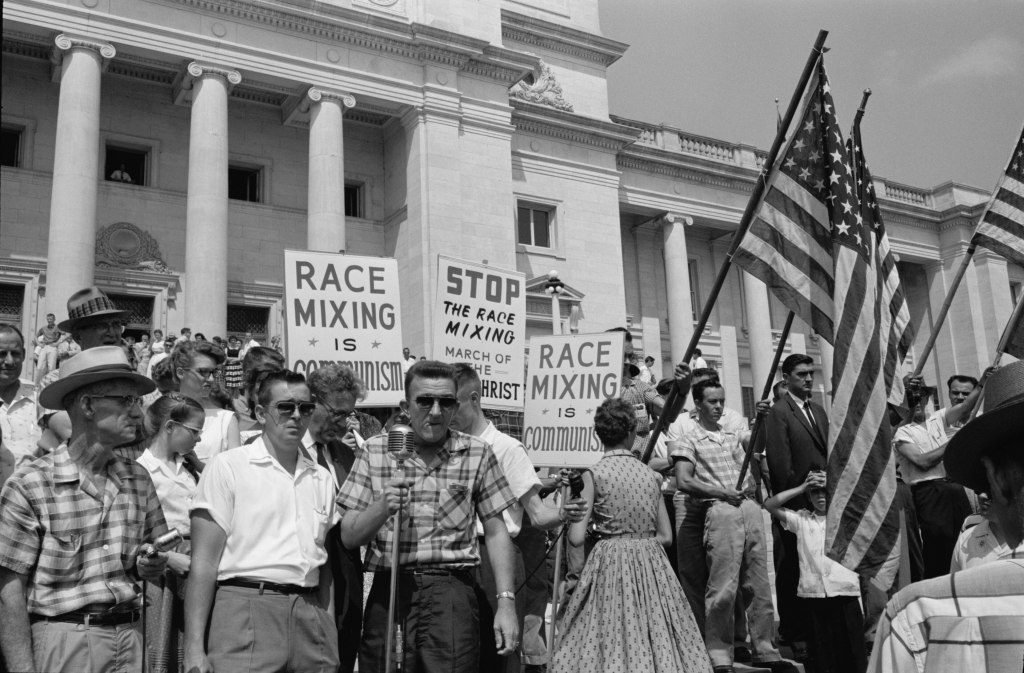
Latin America was one hot destination for Christ’s mujahideen to pick their fight with godless commies and the pagan third world. Some took their paramilitary chops back home to the u.s., linking up with other jilted veterans and domestic hardasses, as the historian Kathleen Belew has documented, and became what we now know as the militia movement. But the real prize was still Jerusalem—not quite “another Israel,” but a rebirth of the “original.” The state of Israel was founded, like apartheid, in 1948, but had the luck of only starting their career as western assets at a time Pretoria was becoming a liability. And their success against the Arabs, punctuating a long decade of western defeats, seemed to prove the dispensationalists had a point. Already in 1970, Carl McIntire was linking failure in Indochina with victory in the middle east, hailing the Jewish state as a model to be followed in pro-war rallies with klansmen and neo-nazis in attendance. It wasn’t long before Jerry Falwell was on the t.v. circuit promoting love of Israel, in particular, as a basic pillar of the platform of the so-called “Moral Majority,” the flagship outfit for lobbying and vote-whipping by the partisans of god.
By then the fundamentalists had ditched their sobriquet and swapped it for the family-friendlier “evangelical.” They had spent the past half-century evolving a cultural ecosystem in parallel, with their own schools and publishers and seminaries, where biblicism and old-time values went unmolested by the modernists and mainline churches. They had made significant strides in radio ministries and public-service television, and were enjoying breakthroughs into cable. The Carter administration, having struck a firm stance against Rhodesia and South Africa, was then taking aim at stateside segregation academies, all-white schools that skated by with tax-free statuses intact, evading integration by invoking faith-based rights. It was this “attack” on “religious liberty,” as the historian Randall Balmer trenchantly exposed, more than any other issue—more, even, than abortion—that canalized the evangelicals into the ballot mills and dollar spigots of right-wing activism. They had seen the great advancements of minorities in the moral desert of midcentury America, and they were dreaming up a civil rights movement of their own.
Bending Towards Apocalypse
On the assembly line of punditry and think-tankery and influencing ops that form the modern Christian right, a sense of being “dissident” is a manufactured good. What they believe they are dissenting from is something they denominate the “postwar consensus,” a term made popular by First Things editor Russell Reno. It’s this consensus, they allege, that neutered modern Christianity and emasculated the left and right alike. The Christian west, racked with guilt after the wars and squeamish over Adolf Hitler, resolved to banish the love of god and kin and other manly things. So for the past fews dozens of years, a sentimental, soft and feminine religion reigned supreme. When pressed on all the ways they differ from modern liberal sensibility, the Christian right resort to a tinned excuse, an example of which was put recently by the pastor Brian Sauvé: “You’re living in an insane asylum, and you think it’s the normal world…. We don’t live in the insane asylum. We do what people did for thousands of years before today.”
Well, no quarrel there: that Christianity has been agreeable to slavery and genocide and other backward irrationalities is a historical fact that’s readily conceded. But the more of this “consensus” stuff you see, the sillier it looks. Western Christians resisted, not endorsed, the postwar push for civil rights at home and humanitarianism abroad. Jingoism was in no short supply during the reigns of Hoover and McCarthy, whose red-scare politics brought the u.s. into alliance with authoritarian despots and fascist thugs well through the unwalling of Berlin. The Reaganites made excuses till the end for apartheidist Pretoria (whose pro-nazi leadership, Reagan insisted, “stood beside us in every war we’ve ever fought”). It was only by the efforts of real dissenters—the socialists, the radicals, the subaltern and the third world—that the lawless empires of the west were ever made to listen to what one used to call the “rules-based liberal international order.” More often than not, these efforts were spearheaded by social gospellers like Dr. King, who knew how to spout a verse or sermon should the need arise.
It was, if anything, the pious stature of those dissidents that gave social reformers their legitimacy. And liberal values, as a result, shaped the turf on which pious reactionaries were forced to play. The first amendment came in handy to seek immunity from civil rights law in private religious schools and institutions. The ideals of equal opportunity could be invoked to use state resources for prayer clubs and chaplains. The liberal order proved amenable to a private sphere of “religious freedom,” where faith was a protected choice, and a public sphere of “religious neutrality,” where faith was a protected ground. “Moral Majority,” Falwell assured the wary in 1981, “strongly supports a pluralistic America.” They’d become something like a n.a.a.c.p. or a.c.l.u. for Christian whites.
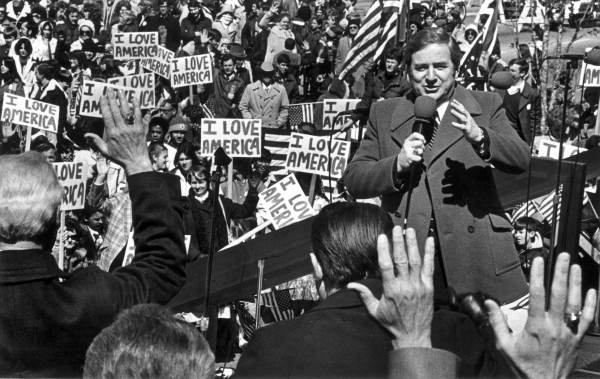
This was a kind of politics of compromise, a form of spiritual harm reduction, a way to clear some space and win some souls (and save some bucks) before the good lord called them out of Dodge. It was a posture of pessimism and retreat. And there was the intractable question of what’s the point. If the arc of the moral universe bent towards apocalypse, and the modern world was little more than Babylon, what was all that politicking even for? Might it not be better, then, to leave things be, save one’s breath or hold it till the day the rapture comes to bring this damned world to a close? Even Kirk Cameron, the former sitcom teenage heartthrob turned star of the first three Left Behind films, had his doubts about a theology which said believers in this life were doomed to lose. In a blog post back in 2003, still halfway through his run as poster boy for Armageddon, Mr. Cameron expressed what might be called apocalyptic cold feet:
I cannot join in the prayer to be relieved of my duty and taken home to Heaven. Instead of daydreaming about the wedding feast in Heaven with all the saints back at headquarters, I’m shifting my thoughts to my Lord’s commands to “Go into the world and preach the gospel to every creature” . . .
I wonder if Jerry Jenkins and Tim LaHaye would ever consider writing a book called Stay Behind, about a group of Christians who would rather stay and reach the lost rather than depart and be with the Lord? I wonder if it would sell?
The charge of fundamentalist passivity is an old one, having been issued from the social gospel left for the fundies’ not doing enough to curb the wickedness of capitalism. But it also issued from the capitalist and nationalistic right, who accused the fundies of ducking their duties in the struggle against communism. Robert Pierce of the John Birch Society went so far as to suggest, in 1977, that rapture theology was itself a sinister ploy by the Illuminati, to lull the doomsday-longing faithful from “any effort to oppose the evil Conspiracy.” This was to put it rather unmildly. Tim LaHaye may have held on till the end to the hope of bodily assumption, but that hadn’t stopped him nor his wife Beverly from leading national crusades to combat porn and feminism and gay rights in the 80s and 90s. Mr. LaHaye had been a Bircher man himself—even claimed to win the soul of j.b.s. founder Robert Welch—and through his work in Left Behind did perhaps the most to mainstream the Bircherite worldview, with its belief that liberal government was the new world order in embryo. And Left Behind, in its gleeful depiction of world-ending gore and doom, furnished a more palatable, mass-audience version of another pillar of the far-right imagination, the psychotic racial snuff novel The Turner Dairies (1978).
There were some who weren’t so content to wait till Christ’s return to get revenge against their enemies. And there were others none too keen on a theology that made the Jewish state the special object of prophecy, not to mention foreign policy. Some were drawn more to the doctrines of “Christian identity,” which hold that aryans, not Jews, are the true heirs of biblical Israel. Others felt that doomsday was something to be prepped for, not escaped, when the shit hits the proverbial fan, as events in Africa and Asia and Latin America seemed to presage. The Turner Diaries—with its fantasies of mass lynching and global holocaust at the hands of an underground white terror network—wasn’t something to be spiritualized into the hereafter, but a blueprint for action here and now. Coherence was a luxury whose hashing-out the paranoid right could not afford. As the white supremo Louis Beam told an assembly of tax protestors, neo-nazis, sovereign citizens and assorted anti-government types in 1992:
When they come for you, the federals will not ask if you are a Constitutionalist, a Baptist, Church of Christ, Identity, Covenant Believer, Klansman, Nazi, homeschooler, Freeman, New Testament believer, fundamentalist, or fiefkeeper. Nor will they ask whether you believe in the Rapture or think it is poppycock!
The occasion was the so-called “Rocky Mountain rendez-vous” in Estes Park, Colorado, a summit of white power luminaries convened at the local y.m.c.a. in response to the federal government’s sordid handling of the Ruby Ridge debacle, described in Kathleen Belew’s excellent study as a landmark assembly in the unified militia movement. To this auspicious gathering, Louis Beam contributed the model of a “leaderless resistance,” which he’d articulated, in his Essays of a Klansman (1983), as a way to “bring [the Vietnam war] on home.” Also present at Estes Park was Lawrence Pratt, former mercenary and longtime president of the Gun Owners of America, whose Armed People Victorious (1990) extolled the virtues of paramilitary death squads in the Philippines and Guatemala as examples to be learned from. The call to avenge the white man’s honor against the third world hordes was taken up with renewed vigor by America’s homegrown “patriots,” but the cross-burners and jackboot-lickers needed a new branding. Easy enough: the internal record from the meetings at the Young Men’s Christian Association at Estes Park refers to them simply as “a meeting of concerned Christian men.”
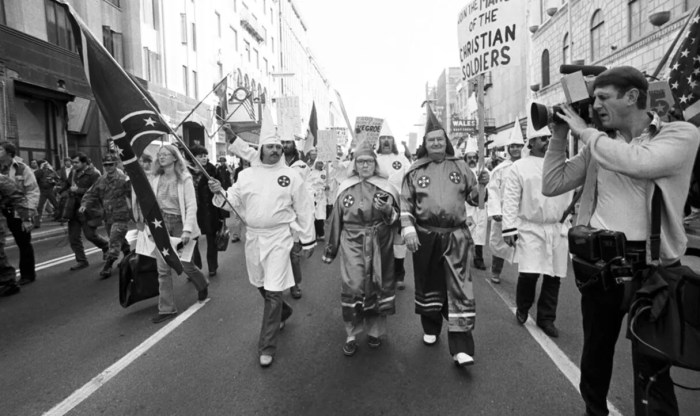
This charming bunch of Bircher paranoids and white power toughs and paramilitary fanatics were never more than a rubbed elbow’s breadth removed from the suits and button-ups on the beltway. Larry Pratt, apart from leading the pro-warcrimes flank of the gun nut lobby, served as an aide in ’96 to the presidential bid of Patrick Buchanan, Ronald Reagan’s former director of communications, with whom Pratt worked in the 1980s supporting u.s.-backed operations in Latin America. In ’92, Mr. Pratt had led his own bid for v.p. on a ticket with Rhodesia fanboy Howard Phillips, chairman of the Conservative Caucus and founder of the far-right Constitution party; whose longtime chum, Ronald Paul, when he wasn’t whinging about central banks and budgets, was one of the leading peddlers of racist and conspiracist and pro-militia propaganda circulated through the u.s. postal service. Mr. Phillips, a born-again Jew, had helped to start Falwell’s Moral Majority with the Heritage Foundation’s catholic founder, Paul Weyrich, and the anti-pornography baptist Tim LaHaye, with whom he also organized the shadowy network of big-money donors, strategists and right-wing kingmakers, the Council for National Policy. And each in his own way has been the recipient and the conduit of the influence of a man whose writings punch well above their weight, the bearded sage of the Christian ultra-right, the sinister presbyterian Rousas Rushdoony.
Mr. Rushdoony was nothing if not a crank, but that most precious sort of crank: your favorite preacher’s favorite preacher, a guy more name-dropped than read. It’s to Rushdoony’s brand of ultra-calvinism that the Christian right owes much unacknowledged debt, starting with his radical insistence that Jesus alone is “king.” The earth did not belong to Satan, whose grip was far from total. There didn’t need to be an antichrist dictator or a rapture, either. What Jesus’ kingship meant, as detailed in Rushdoony’s 3-volume doorstopper (1973–99), is that Christ “reigns now to subjugate all His enemies, so that the triumphant prophecy be fulfilled…
In terms of this purpose, the covenant men were told by Jesus Christ, “All power (all authority or dominion) is given unto me in heaven and in earth. Go ye therefore, and teach all nations…” (Matt. 28:18–19). The church is sent into the world as part of Christ’s imperialism, to subjugate the world to His reign.
This meant that every sphere of human life, the public as well as private, would need to submit to the word of god, and the state was tasked with the enforcement of biblical law. Which meant it all—like banning blasphemy and gay sex under the penalty of stoning, but not the Jewish bits, of course, like keeping kosher. Jews had nothing to do with it; except to yield, like all unbelievers, to Christians’ planetary rule. The reign of Jesus must be global, but this was no social gospel utopia. The ideal Rushdoony preached was feudal. Husbands should lord over their wives like pastors do their flock, while the state deals in civil punishments and the safeguarding of property. And though it held the power to dictate matters of the bedroom, the state had no place in welfare and education. The worst parts of state control and state neglect were joined in Rushdoony’s model of the kingdom, where all forms of authority had a strictly biblical design. All forms of government were illegitimate that fell short of Christian shari’a. And Rousas Rushdoony, who admired the confederate chaplain Robert Dabney and praised the piety of the prewar south, believed the u.s. government had been defying Jesus’ law since at least 1865. Small wonder, then, that Rushdoony’s project of restoring antebellum ultra-orthodoxy would get the label “Christian reconstruction.”
Thanks in part to the efforts of Larry Pratt and Howard Phillips (disciples of Mr. Rushdoony) and the Ron Paul staffer Gary North (Rushdoony’s son-in-law), Christian reconstruction became a mainstay on the paleoconservative right. Its ideal of a “reconstructed,” “biblical” society appealed to lost-cause southerners and the votaries of the market, who agreed that property was sacred and the government illegitimate. It lent a cloak of theological coherence to the Birchers and the goldbugs and the vigilante militias. It gained a special traction among the homeschool movement, which the reconstructionists nurtured and promoted in the wake of school desegregation. To the Jerry Falwells and Pat Robertsons on the normie religious right, where dispensationalism still held court, a full embracing of Rushdoony was a stoning perhaps too far. But to the reconstructionists, that “live and let live” attitude of Reagan-era Christian politics—which accepted catholics and Mormons, and even atheists and Jews—was no less than a satanic capitulation. The principle of neutrality was itself a false religion. “The appeal to religious liberty,” wrote Gary North in 1982, was only valid “as a tactic for a short-run defense,” a trick for buying them “some time, some organizational freedom, and some power.” Yet the end goal must always be clear:
[W]e must use the doctrine of religious liberty to gain independence for Christian schools until we train up a generation of people who know that there is no religious neutrality…. Then they will get busy in constructing a Bible-based social, political, and religious order which finally denies the religious liberty of the enemies of God. Murder, abortion, and pornography will be illegal. God’s law will be enforced. It will take time.
And time, thought they, was on their side. The reconstruction of America might take centuries; and the sturdy folk of the Pacific northwest were already digging in their spades. It was there—for years a hotbed of militia and survivalist activity, where racial separatists declared “Cascadia” the national homeland for the whites—that Christian reconstructionism got a new life. Its chief purveyor is Douglas Wilson, the “paleo-confederate” founding pastor of the hardline calvinist c.r.e.c., whose congregations have been turning the town of Moscow, Idaho into a colony of puritanical reaction. Much of his community are transplants, from nearby backwaters but also from the cities, where rainbow flags and alien tongues portended certain doom. But theirs is not a permanent withdrawal; the Moscow theocrats intend to grow. New generations are being groomed under the tutelage of c.r.e.c.-administered private schools, whose curricula are replicated nationwide. They have their own printing press and their own four-year college. The reconstruction of Moscow, Idaho—sandwiched between two secular universities, causing friction between the locals and the newcomers—is but a beachhead in a “cold” “civil war,” as Mr. Wilson says, that hasn’t yet turned “hot.” Their latest lodgment is in Washington, d.c., where an outpost of Mr. Wilson’s church was launched last year to minister the nation’s leaders, in a campaign they called “a mission to Babylon.”
Holiday in Babylon
On the eve of the millennium, with the impeachment of William Jefferson Clinton for the sins of fellatio and the fibs thereof having gotten thoroughly drubbed, the outlook for Christian victory looked bleak. Paul Weyrich, four days following the president’s acquittal, published a “dear friend” letter whining how the “moral majority” he’d helped to incubate had lost. The “ever-widening sewer” of society was in the iron grip of “Cultural Marxism” and “m.t.v.,” you see, with even Disney spewing “viciously anti-religious, and specifically anti-Christian” junk. The rot was threatening “to control literally every aspect of our lives.” Mr. Weyrich was no rapture-ready protestant, but a loyal papist through and through, yet his solution to the culture’s “collapse” was the same: escape. Christians must “quarantine,” “drop out” and “find places” to live “godly, righteous, sober lives” away from it all. Moving to Idaho, Mr. Weyrich felt the need to clarify, isn’t what this had to mean, strictly speaking. Neither did he, for that matter, rule it out.
(Idaho did get the recommendation of Gary North, who earned the nickname “Scary Gary” through his warnings about the chaos and calamities to be visited on the nation with the y2k bug. The greenery and open spaces of Cascadia would be ideal for Christian patriots to bunker up and make it through a s.h.t.f. scenario—a good thing, as Gary North would have it, because social collapse and political annihilation were just the things people like him needed to begin the project of a “Christian reconstruction.”)
Neither North’s nor Weyrich’s catastrophism came true. The fortunes of the culture war would shift in just a few short years. And while the legalization of gay marriage did push the conservative pundit Rod Dreher to float self-exile as a Christian recourse from the Obama years’ degeneracy—a theme he milked to a book-length bestseller in 2017—here was Kirk Cameron that same year sounding positively chipper, and rejecting any grounds for feeling blue:
I don’t see anything in the scriptures that should leave Christians discouraged, believing that defeat is inevitable. What I see, historically and in the scriptures, is that Jesus Christ would come and that he would set up his kingdom and that it would be a spiritual kingdom that would animate the people and their actions here on earth . . . that we would push back darkness, we would stop corruption, and that we would disciple nations . . . and that his kingdom wins, it doesn’t lose.
It wasn’t just the plaintive and alarmist tone of Left Behind that Mr. Cameron left behind, but really what had been for a century and a half the Christian right’s prevailing mood. That mood had seized them ever since they came to grips with being captives in the Yankee Babylon, and gained a sharpness and coherence in the cold war. The red menace made the threat of one global apostate government seem stark, and left traditionalists feeling vulnerable to reform. The u.s. claim to leadership in freedom and democracy, at a time when an integrated economy was a fait accompli, meant America’s own social evils had to go. Concessions to the age had to be done. The dream of a Christian nation and a sanctified civil government would have to be deferred until Jerusalem; this was Babylon’s dispensation, after all. Small and limited government was the stuff. Tolerance and neutrality were the prerequisites in a market of ideas, where faith had to be an individual’s private choice.
These postwar, cold war compromises placed them at the mercies of democracy, a fickle public and a secular constitution. That way lay Obergefell and Biden’s open border. But the new crop of Christian nationalists aren’t saddled with the embarrassment and futility and moral stain of Vietnam. Their experience of war, such as it is, is the war on terror: lower-intensity, protracted and perpetual, without a need to be choppered out of a spiritual Saigon.
It may seem on close inspection that very little should unite the gang of hardline calvinists, charismatics and traditional catholics who together form the modern front of Christian nationalism. Yet what they share is not theology per se, but a common rhetoric and a new, triumphant mood. They are looking less to Falwell and more to Rushdoony. They are sick of being, to borrow from their own vocabulary, “cucked.” They aren’t wishing to be raptured out or holed up in a bunker, and won’t rest content to keep religion behind closed doors. The external application of the faith—that is to say, political dominion—is all they seem to care for, as they delight in cruelty and the spectacle of force. Meek and mild their Christ is not, but the avenging lion of injured manhood and the vanquisher of woke. If the face of yesteryear’s godly partisans was the weepy demagogue or the moralizing huckster wailing about doomsday, the image now is the self-satisfied, cocksure, coprophagous smirk of the political influencer, gloating “Christ is king.” And they’re convinced they’ll see his kingdom materialize right here in god’s America, even if it means the end of the republic as it’s been known.
.jpg)
There are, I think, three important reasons this is so. The first and biggest was the end of the cold war. The existence of an international socialist current, and the presence of a domestic left with which to reckon, had forced the pious types into a tempering alliance with the laissez-faire economists and the cruise missile enthusiasts. Anti-communism became the common language of the political right, and liberalism, in the classic sense, its common grammar. When the iron curtain fell it took away the coalition’s whole raison d’être, and left in place a certain god-shaped hole. Religiosity, which seemed at first to be the right’s most parochial and embarrassing liability, emerged instead as the only ideology that stuck. Marion Robertson, a.k.a. “Pat,” repurposed the mailing list of his failed presidential run to organize the Christian Coalition, the largest conservative faction of the 1990s, which along with the constellation of assorted “family values” groupings proved a perennial thorn in the side of Bill Clinton. And despite a brief resurgence of war appetite under Bush, it was clear that at the so-called end of Fukuyama’s history, the battles would be waged in spiritual terms.
It helped that nearly any right-wing passion could be assimilated as a theological matter, in a way that didn’t work in the reverse. The calls to center Jesus in the public square, for instance, made an awkward fit to the libertarians, with their belief in personal freedom and the limiting of the state. But in the “tea party” movement organized against Obama, which some were keen to see as a grassroots concern for deficits and size of government, Glenn Beck could stand by the steps of the Lincoln memorial and pitch the act of tax protest as an exercise of faith:
This day is a day that we can start the heart of America again. And it has nothing to do with politics. It has everything to do with God, everything, turning our face back to the values and the principles that made us great.
(In a 2011 study by the Public Religion Research Institute, only 27% of tea party supporters identified as “libertarian,” versus 75% as “Christian conservative.”)
Related to this, secondly, were the growth and longevity of a parallel religious subculture. Parochial schools and bible colleges and the Christian homeschool movement produced an insular and oppositional social base. Religious broadcasting boomed with the deregulation of the f.c.c., placing the media at the service of commercial and ideological interests and repealing the requirement to air opposing views. Christian media turned a handsome profit, filling the airwaves and the bookshelves and the cable networks with faith-based alternatives to the godlessness of Hollywood and the secular mainstream. The internet only pushed this to extremity. Since the 1970s, the gun market and lobby and affiliated community have catered to the fever dreams of righteous militias and vigilantes squaring off against a secular society run amok. On the politer side, the progressives’ strategy of using the courts for social reform has seen its foil in the emergence of a conservative Christian legal movement, whose key achievements have been the expansion of religious privileges and the long-awaited demise of Roe v. Wade.
To a considerable degree, Gary North’s proposal of strategic retreat to “train up a generation,” immune to secular temptations and prepared for a theocratic takeover, has begun bearing its fruit. And their influence is leaking well beyond the crackpot fringe. North himself made inroads with the public by rebranding as the “tea party economist,” riding the coattails of his more famous, longtime associate and collaborator, Ron Paul. In 2012, the religion scholar Julie Ingersoll observed how more conventional evangelicals like Kirk Cameron were palling around with reconstruction-adjacent figures like David Barton, the “tea party historian,” whose beliefs in a divinely written constitution and America’s theocratic founding have shaped Christian school curricula, and been promoted in recent years by Charlie Kirk’s religious program, “t.p.u.s.a. Faith.” The effect of this commingling has been the exposure to a mass audience of the barking lunatic fringe, especially on platforms like YouTube and Elon Musk’s refashioned Twitter, which reward the vulgar and the incendiary.
The third factor was power, and the right’s proximity to it. The plague year of 2020 threw their new attitude into a stark relief. I remember seeing then among evangelicals a bit of your more typical doomsday alarmism—not about the covid-19 pandemic, but about the public health responses. Church closures and mask mandates were taken as the omens of anti-Christian persecution. The vaccine was a microchip, and the microchip was the mark of the beast. That this all coincided with the “black lives” protests on the boulevards and d.e.i.-speak in the boardrooms showed the hand of a great apostasy of wokeness. But as the lockdowns lingered on into the coronavirus’s first fall, the Christian right were largely disinclined to wait for Jesus in their bunkers and prep for kingdom come. They were dreaming of defiance, not quarantine or retreat. In September of 2020, Douglas Wilson of Moscow, Idaho wormed his way into the spotlight when his congregation shuffled from their pews to indulge in down-and-dirty civil disobedience, in the form of unmasked freedom-singing by the city’s capitol, in protest of the tyranny of public health.
For a long time, wrote Mr. Wilson near the end of 2025, the views of him and his sect “were too radical for the evangelical normies, and so we were considered outliers, and were treated that way. But over the last five years,” he suggested,
many of these normies have realized that we were on to something, and that when Clown World moved into the chase scene of Act 3, we were prepared for it all, and they weren’t.
The beliefs of those “evangelical normies,” it so happens, had been mutating into stranger and more lurid outward forms. They had converged, by slight revision to the details but the same millenarian impulse, with the political mythology of Q Anon. The Q Anon conspiracy theory—with its satanic secret government, the impending day of reckoning, the grim predictions by the knowers of hidden truth—made a natural pairing with the dispensational leanings of the evangelicals, 1 in 4 of whom counted themselves in 2021 among believers in the anonymous 4chan user known as “Q.” The Q movement—which proclaimed in breathless tones that Donald Trump was working hard behind the scenes to take down the cabal of migrant-loving globalists and devil-worshipping child diddlers—was, much like the newspaper eschatologists and the calculators of the rapture, still a spectator sport. The plan, they told the doubters, is something you just had to trust. Trump may come in glory and vindication at any time.
When the awaited “day of the storm” failed to arrive, and Mr. Trump fell short of reelection, a reassessment of the doctrine was in order. The storm would have to be induced by their own hands. And storm believers did that 6th day of January in 2021, as a mob of Q holdouts and militiamen and groypers and patriotic blowhards flubbed their merry way into the nation’s capitol, to stop the election of Joseph Biden, behind the cries of Trump being their president and Jesus Christ their king. All they needed were some courage and permission.
The Great Unwokening
When the good lord Jesus stood up the earth in 1844, the date predicted for his return by the crank revivalist William Miller, it became known as “the great disappointment.” Yet disappointment was hardly fatal to the apocalyptic sect of Millerites, who couldn’t shake the credulous feeling that something must have occurred, and reinterpreted Miller’s preachments into the basis of newer, less convulsive creeds, most notably the seventh-day adventist church. (They were also incorporated into the syncretic mythos of Bahá’í.) It made the influence of William Miller more resilient, not less. A movement of ecstatic end-times thrill seekers, who sold their things and flocked to hills to nab the choicest views of Christ’s return, settled down for the humdrum task of building lasting institutions. Something similar happened in the cult of m.a.g.a. in the wake of the January insurrection. The sheer disorganized intensity has, for a moment, fizzled out. But the essential pulse of revelation—that the lord himself appointed Donald Trump to do his earthly bidding—has withstood the trials and tribulations of the times.
The presidency of Biden was more to them than a disappointment, great or small, and America under Joe was worse than wicked. She was a land infested with demons: supernatural entities, sinister and invisible, whose existence ceased being the stuff of metaphor or movies, and became a topic of political significance to grown-ups. Back in the 1980s, popular ministers in the charismatic branch of Christianity started mapping a political geography of demons, on the premise that entire places, institutions, governments and countries could be possessed. Against these demonic foes, the holy ghost equipped believers with the gifts of miracle work and divine wisdom and the appointment of modern “apostles” and “prophets,” with whom the deity speaks in dreams and codes.
The charismatics have always had a flair for showmanship, claiming pentecostal powers of prosperity and healing to which audiences swarm like flies. It was only logical they’d apply their gifts of self-help and positive thought to the political chaos under Biden, as millions of credulous voters primed themselves for spiritual war. America, they foretold, will be cleansed of demonic influence. Mr. Trump was still divinely picked to do it. The age of Babylon and Biden was just a momentary setback, and backing Trump was nothing short of spiritual duty.
The prophets of m.a.g.a. are an outgrowth of a movement or a network called the “new apostolic reformation,” a label they deny being a part of each time it’s brought up. But the term itself was coined in the ’90s by Charles Peter Wagner, one of the movement’s leading figures. From 2021 to ’23, Wagner’s acolytes and disciples like Lance Wallnau and Sean Feucht appeared with other right-wing charismatics on the “ReAwaken America” traveling roadshow, funneling the dregs of Q Anon and election truthers and the cargo cult of Trump into more theocratic directions. Mr. Wallnau would go on to join with Charlie Kirk in the “Courage Tour” of 2024, making the rounds through demoniacally contested swing states to get out the spiritual-minded vote. In conferences and rallies around the country, believers joined in the recital of the so-called “watchman decree,” a statement of the n.a.r.’s beliefs. It preambulates with the idea that the church is “God’s governing body on the earth,” “given legal power from heaven,” and only gets weirder and more sinister from there. All branches of the government, it commands, must honor the god and scripture. That America is “strong” is a declared fact. It takes a hard stance against such evils as “wokeness” and “the occult,” and manifests that “america shall be saved!” Part prayer, part manifesto, the watchman decree gives you a glimpse into the mental arsenal of those who think that something’s true if it’s believed, and whose ammunition is the power of magical thinking.
They also have a lot of guns. At times it can be difficult to tell where the American Christian lifestyle ends and the Yankee gun culture begins. Some protestants venerate the firearm the way they say the catholics worship icons, and they revere it as if imbued with powers unseen. Boastful of their willingness to shoot first, obsessive-compulsive with being at all times strapped, positively giddy with the thought of emptying a mag—it’s not unfair to say that u.s. gun culture, at least in its most rabid and enthusiastic form, looks a dreadful lot like a cult of death. It has done so since the racially anxious 1970s, when the gun lobby stopped pandering to the marksman and the hunter, and started playing up the god-given right to murder trespassers and take up arms against the state. The vanguard of that pivot was the hard-right flank of the n.r.a.’s right flank, the longtime leader of the g.o.a., the Christian reconstructionist Larry Pratt. Mr. Pratt, you may recall, witnessed what the paramilitaries were up to in the ’80s in places like Guatemala and the Philippines, and proposed that god-fearing Yanks ought to take up the same tack. The gun culture he helped to foment—with its exalting of sacred violence, its spectacle of manly strength, its symbolic fetish for the implements of death—resembles nothing quite so much as one other subculture in particular, one whose folk practices give glory to the morbid and the lethal, and also trace their origins to the death squads: the narcotraffickers.
It’s been said that American Christianity has something of a “cowboy” mentality, as detailed in Jesus and John Wayne (2020), Kristin Du Mez’s study of red-blooded religion in the country of god and guns. This bears a slight correction. The proper archetype or figure of the u.s. Christian right’s symbolic pretension is not the rugged cowboy, but the caudillo.
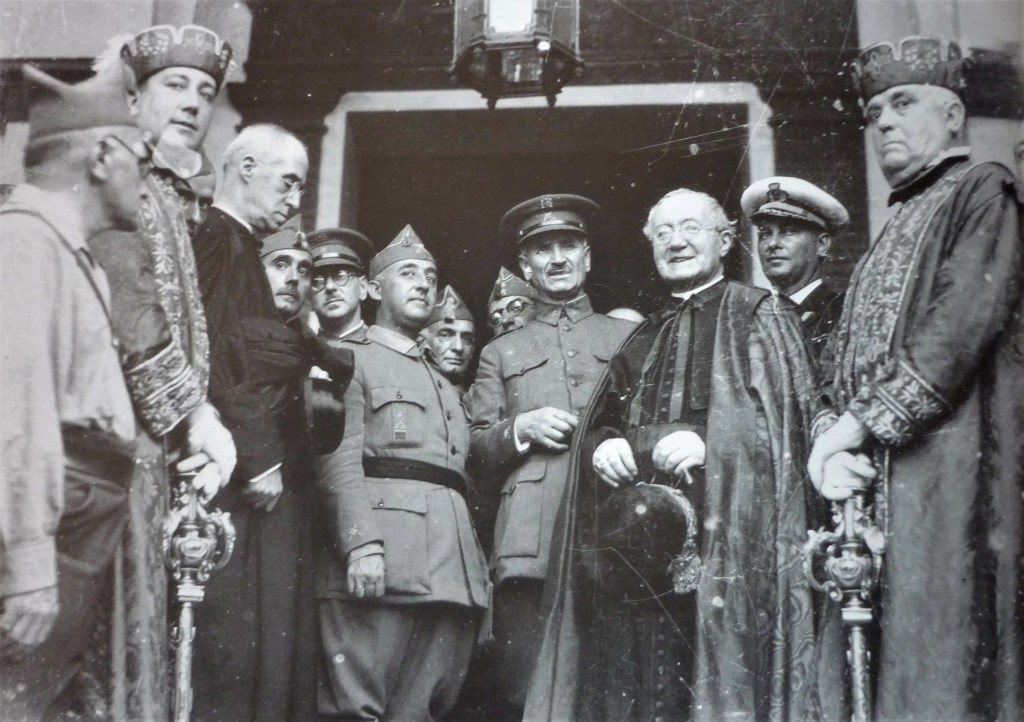
The Patrullas de autodefensa civil of Guatemala were deployed at the service of the u.s.-backed genocidaire, José Efraín Ríos Montt; in Mindanao, the Alsa Masa vigilantes were conscripted by police chief Franco Magno Calida into a pentagon-approved auxiliary of the Filipino state. On paper, the u.s. penchant for indulging cold war dictators and strongmen was premised on Jeane Kirkpatrick’s famous distinction between “authoritarians,” who can be trusted, and “totalitarians,” who can’t. In practice, this meant the toleration, not to mention the nurturing and fostering, of incorrigible nazis and tinpot racialists and neofascists in their ranks, who were preferable to anything smelling even of a socialistic whiff. Larry Pratt and his pals were associates of the World Anti-Communist League, a sprawling network that put capitalist true-believers into close collaboration with the death squads and the dictators who employed them. Their u.s. chapter president and world chairman in the ’70s was eugenics enthusiast Roger Pearson, who pulled into their orbit actual third reich veterans along with fascist newbies from Ordine Nuovo, guys who’d cut their teeth in Italy’s “years of lead” and went on to work through w.a.c.l. partnerships in South America’s operation Condor. Pearson’s successor, John Singlaub, who worked with Mario Sandoval and Roberto D’Aubuisson and raised millions for the contras, was also a member of the Council for National Policy, the same gang of Howard Phillips and Paul Weyrich and Tim LaHaye.
It doesn’t pay not to remember that the gun-toting theocrats of America are the natural allies of the abortion clinic bomb-throwers and militia-minded thugs one used to hear so much of (that is, until the Trump administration decided left-wing violence was the only kind there was). In a transnational circuit of hard-right extremists doing the grunt work of the rich and powerful, the Christian ultras are just the local node.
For all their affectations of opposing the largeness of the state, they’ve always loved a man in uniform and had a taste for boot leather. This predilection received an early, and somewhat subtler, airing by the “post-liberal” catholic integralists, such as the law professor Adrian Vermeule, who drones obscurely about “the dangers of a weak executive,” laments the public’s “tyrannophobia,” and urges “the strong hand of legitimate rule” to “curb the social and economic pretensions of the urban-gentry liberals.” The liberal order, in Vermeule’s telling, invites chaos and misrule; a tough-minded ruler now would stave off the need for a tougher one tomorrow. In the less polished corners of the Christian right, tomorrow is today, and there are serious and open discussions on the desirability of an American caudillo who won’t think twice in taking down the left, on the model of the Spanish dictator Francisco Franco.
The Yankee generalissimo, some insist, would have to be a protestant. Or maybe a baptist Pinochet would do. Some members of the prayer squad get moist and tickly at the prospect of snatching up leftists into choppers and depositing them into the sea. Stephen Wolfe, conversely, prefers that his “theocratic Caesar” be “measured.” Corey Mahler, podcaster and “theologian,” preaches that the mustached painter from Vienna was himself “the last true Christian prince.” Jack Posobiec, a catholic, lauded both Pinochet and Franco as the models for how the right should deal with leftists, in a book that boasts the endearing title of Unhumans and an endorsement by j.d. Vance. Writing in First Things, James Abbotoy qualifies his earlier zeal for “protestant Franco” as a thought experiment, a hypothetical which they one day might have to turn to “given the facts of mass immigration and the collapse of the family.” In fact, such speculation is unneeded. It hasn’t been too long since Pat Buchanan praised Franco and Pinochet publicly as “soldier-patriots,” or when w.a.c.l.’s honored patron Ronald Reagan said that the American volunteers who fought for Spain’s republic in the civil war had been “on the wrong side.” That there is even an argument to be had suggests that Jeane Kirkpatrick’s formulation may be a distinction without a difference.
Some differences of theirs may be unsmoothable. The sign seekers and miracle merchants of the n.a.r. have always been kept a cubit’s length from the hardline calvinists, especially the bearded and bookish reconstructionists. The trad caths and integralists, who run increasingly in these same circles, will never get their brethren on board with Rome. They differ among themselves on whether the u.s. constitution was intended as a sacred Christian charter, or was always a godless liberal sham. They differ, too, on the millennium: will the church succeed in christianizing the entire planet, or is that more a metaphor? Which laws of the old testament must be enforced? In the past year, their deepest and most divisive split concerns the state of Israel—whether it’s Washington or Jerusalem that is the center of the lord’s plan for humanity, and what that means for Christian attitudes about Jews.
Some may squirm away from the question, while others are too used to warmed-over dispensationalism to leave their zionism in the last century. But the inescapable impression on the pious right is that Israel, having lost its special stature as a cold war priority, has also lost its central place in prophecy. A lot object to having their Christianity hyphenated with Judeo, which has freed up the crowd of “noticers” to say what’s really on their minds. And with the cold war’s pieties’ demise, some brave, inquisitive souls are starting to ask the searing questions of our time. Like: do women possess agency? Is the country ready to strip females of the vote? Does the commandment to honor thy father and thy mother require racial purity, or is interracial marriage sometimes allowed? How ethnically homogeneous does a Christian nation have to be? Does the lord’s grace to whites also apply to blacks?
For the moment, the main impact of this drooling lunacy is to make a brand new crop of chinless, doughy nobodies who have trouble keeping eye contact feel like they have a platform, which indeed they do. Whether anyone is buying it is a separate point. Americans are more secular and irreligious and truant in their worship than they’ve ever been. Despite rumors of a “vibe shift” or a generational revival, church attendance is at a record low. What has happened is a hardening and consolidation and emboldening of the existing faithful core. And this has happened not in spite, but because of changes in the country’s ecclesial habits, including the migration of churchgoers into “non-denominational” pews, and the broad unchurching of Americans overall. Formal faith communities have a moderating and disciplining effect on those who’d otherwise use YouTube to hear god’s word. Recent research suggests that support for the u.s. president is more pronounced among believers who fail to honor their Sunday duties than among those who do. According to the findings of a 2023 survey, only 54% of “Christian nationalists” even go to church.
Yet it’d be wrong to take the effusions of right-wing religiosity as a function of observance or theology. If religion itself were all that mattered, then the migration into the country of millions of hispanics, mostly devout catholics but also largely evangelicals, wouldn’t be the cause of so much sweat. But in a secular and pluralist and racially mixed society, “Christian” is more like a lifestyle brand. It’s a cultural marker of identity, which is how an atheist loudmouth like Richard Dawkins is able to call himself a “cultural Christian,” getting warm and fuzzy over remembrances of carols and cathedrals while being quivery about green street lights during Ramadan. Increasingly, “Christian” is the brand of a political identity subscribed to by those who imagine themselves demographically under siege. Dawkins’s late comrade in unbelief, the journalist Christopher Hitchens, observed in 2010 that “[i]n a rather curious and confused way, some white people are starting almost to think like a minority, even like a persecuted one.
What does it take to believe that Christianity is an endangered religion in America or that the name of Jesus is insufficiently spoken or appreciated? Who wakes up believing that there is no appreciation for our veterans and our armed forces and that without a noisy speech from Sarah Palin, their sacrifice would be scorned? It’s not unfair to say that such grievances are purely and simply imaginary, which in turn leads one to ask what the real ones can be. The clue, surely, is furnished by the remainder of the [tea party rally] speeches, which deny racial feeling so monotonously and vehemently as to draw attention.
Since then, Hitchens’s remarks on the early pulse of “populist” reaction have been borne out by a body of empirical research, tying support for the tea party and m.a.g.a. to white people’s anxiety over a perceived loss of social status and a national decline. The election to the oval office of a well-credentialed black man (actually, as black as he is white) whose pastor said true things about the u.s. government (which Mr. Obama later denounced) induced more than a crisis of identity. In a time of feminism and critical race theory and illegal immigration, it caused an existential panic. A study found in 2012 that more than half of white Americans—with 2/3 of Republicans and 2/3 of white evangelicals—believed whites had it just as bad, in terms of racism, as did minorities. One can imagine some of those respondents must’ve wished to say whites had it worse.
Three years later, a young man in South Carolina gave a glimpse into what such a minority, pale of flesh and thin of skin, might pull off when backed into a corner. On the 17th of June, Dylann Storm Roof, 21, stepped into the historic “Mother Emanuel” church in Charleston, one of the oldest black congregations in the country. He joined an evening bible study, listened to the participants, waited for a prayer, pulled out a Glock and emptied 7 of his 8 magazines, 11 bullets each for a grand sum of 88, into 9 of the parishioners. In a selfie he uploaded to his personal website only hours before the shooting, Mr. Roof is pictured in a jacket patched with two conspicuous flags: apartheidist South Africa and white Rhodesia.
What Rough Beast
The Last Rhodesian is, in fact, the title of Mr. Roof’s website, on which he left behind a semiliterate manifesto evidencing the failures of the education system. Of particular notability is his disdain for the white-flight suburbs—which represent “nothing but scared White people running”—as well as for the proposal of a white man’s enclave in the Pacific northwest; an idea which Roof, rather astutely, understood to be the wish for the biggest, scaredest suburb of them all. No, no, opined the Charleston church shooter. Why should the white man flee? In the prison diary he wrote awaiting trial in 2015, festooned with symbols of white supremacism and religious iconography, Dylann Roof extended the theme to matters otherworldly:
I cannot agree with the form of Christianity most modern preachers preach. It seems to me that this form of Christianity says, “Leave it to God.” “There is nothing you can do about it.” “Ok, well maybe you can do something, but don’t, because it’s not your place.” And I can’t agree with this. I see some people who seem to use Christianity as an excuse for not doing anything. They tell themselves they are being pious, but they are really being cowardly. Their piety is their excuse. But Christianity doesn’t have to be this weak, feeble, cowardly religion. There is plenty of evidence to indicate that Christianity can be a warrior’s religion.
The perpetrator of the Charleston massacre may have wished to fire the opening salvo in an apocalyptic race war, but what he struck was a blow in a battle of religion. It was, in one sense, an attack against the theological left—the self-organized Christianity of African Americans, with its roots in abolitionism and the black freedom struggle, was always a social gospel—committed by a spiritual descendant of the klan. It was also a fraternal strike within the theological right: a rejection of the weak, escapist faith of an older fundamentalism, and a harbinger of a new militant mood. The public’s appetite for racial terror and explicit ideology may be slim, but Mr. Roof had his finger on a distinctive pulse. In this the Christian nationalists, who share their label with the ideology of the architects of apartheid, are carrying the flame.
This isn’t to imply that Christian nationalists all are secret shooters in waiting. No—they only make excuses for the violence, change the subject swiftly, and deflect blame to someone else. (This is what Charlie Kirk was in the middle of when he died, doing what he loved.) They only feed on the same stale propaganda, regurgitate the same rancid points, run in the same circles with fascist freaks, and whistle to the same dogs. To an older breed of fundamentalist, the threat was a national backsliding: a once-great white Christian nation was giving in to rock music and race-mixing and a conspiracy of elites. The nation fallen to apostasy, judgment day must surely come; but until then and with some pluck they could win back a few souls of the lost, who were their kin after all. It isn’t now apostasy which tickles the amygdalae of the new nationalists, but “invasion” and “replacement.” A faithful remnant, the real Americans, are now besieged by unbelonging hordes. This mentality is put succinctly in one of Stephen Miller’s cherished bedtime stories, The Camp of the Saints (1973), written by the French monarchist Jean Raspail, whose toxic swill of a novel warns of the west being destroyed by swarms of feces-eating immigrants from India. The title is lifted from the book of Revelation, where it refers to the holy city under siege in Satan’s last hurrah. Yet the apocalypse isn’t any more to them a script for a future confrontation. Gog and Magog are already inside.
Thoughts like these have long been peddled by m.a.g.a.’s intellectuals, among whom the Straussian creeps at the Claremont Institute stand out. Glenn Elmers, a Claremont fellow, wrote in 2021 that “most people living in the United States today—certainly more than half—are not Americans in any meaningful sense of the term.” Kudos where due: men like Mr. Elmers seem to “know what time it is,” which is to say they know their time has come. A growing number on the ultra-right are achingly aware their side may never again command a democratic majority; and internal quarreling may defeat them if they do. The solution Elmers proposed is “counter-revolution”:
[W]e must all unite around the one, authentic America…. Practically speaking, there is almost nothing left to conserve. What is actually required now is a recovery, or even a refounding, of America as it was long and originally understood but which now exists only in the hearts and minds of a minority of citizens.
The past two years since Donald doddered back into the oval office have been a gambit of extraordinary proportions. The efforts to remake the country in m.a.g.a.’s image, to purge the populace and silence dissent, and to wield the government like his personal property have an unmistakable purpose: the entrenchment or enabling of a white minority rule. This isn’t, in the strictest sense, a simple function of the skin color divide. Neither, for that matter, was apartheid, which depended on the buy-in from black chieftains to sustain the white man’s “Christian way of life.” The same anxieties are reflected in the Trump administration’s immigration priorities, which aim to cleanse the undesirables back to their third world “shit holes,” while fast-tracking the mass importation of Afrikaners on taxpayer dime. The president’s ear is closely had by billionaires like Elon Musk and Peter Thiel, who grew up on the right side of the color line in the South Africa of b.j. Vorster and p.w. Botha, and who know a thing or two of the anxieties of whites. That right-wing Americans under Trump would take for their own name the ideology of Verwoerd and Vorster and Botha—Christian nationalism—should be nobody’s surprise.
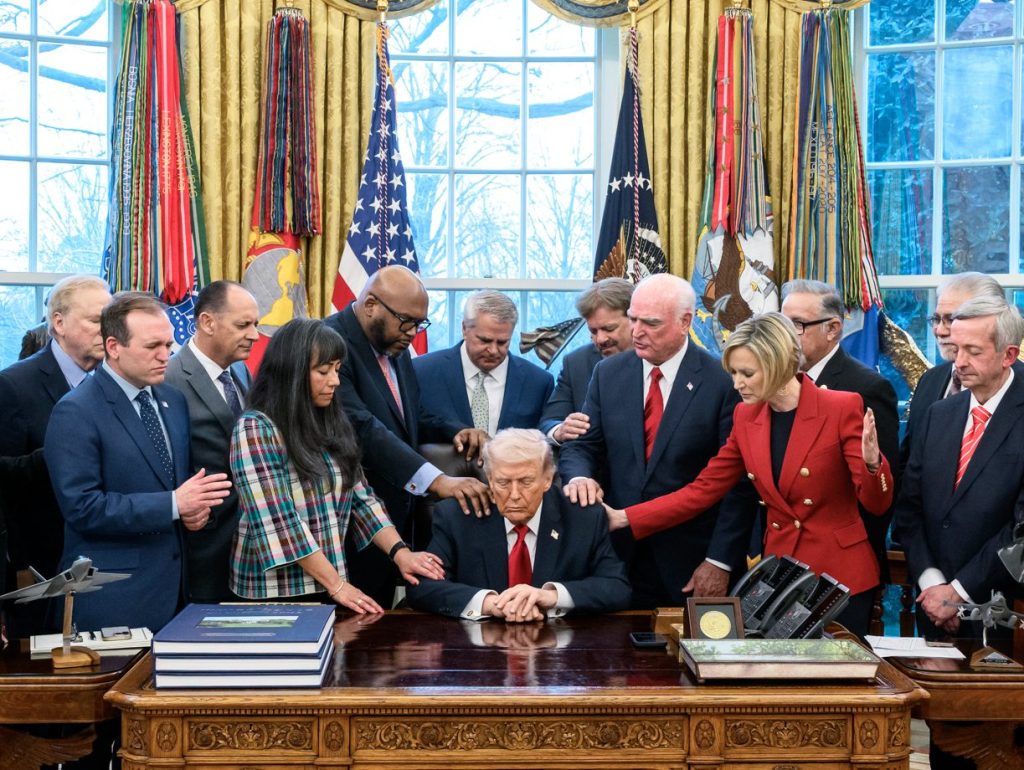
There wasn’t, on the face of it, any reason to assume a twice-divorced New York Democrat would become the favored champion of the Christian nationalist right. When he first ran in 2016, the more obvious pick was Rafael “Ted” Cruz, a man who’d risen from the ranks of the tea party’s god brigade, and whose father, a n.a.r.-linked pastor, prophesied in 2012 that the lord anointed Ted to be his end-times “king.” Jesus had different plans. True enough, the evangelicals were sluggish to embrace the reality t.v. star and white-collar crook. But when he edged out the more popular Hillary Clinton by a sliver of the electoral college, it seemed a blessing. When he endured the battery of the media and the inquisition of prosecutors, he looked a suffering saint. When he survived the nicking to his ear of a sniper’s bullet, it appeared a miracle. He spoke in tongues: the languages of business and prosperity, the p.t. Barnum salesmanship and confidence of a hustler, the love of self that is the true American creed. He said the things they said you couldn’t say, did what they said you couldn’t do. He peered inside the soul of “authentic” America and saw instead her ulcerated gut, putrid and dysbiotic, coated with the germ of the old slaveholder religion. He knew what sort of junk they liked and how to make it sweet. All he had to do was let the microbes do their stuff.
Nostalgia and fellow-feeling are the wrong frameworks to understand where all this came from. The version of America they despise is the only one they’ve ever known. Theology likewise misses the point. It isn’t their religion that shapes their politics, but vice-versa. Religiosity, much like jingoism, is an instrument for lashing out—at all the foreigners and infidels they blame for their misfortunes, imaginary or not—and they are doubling down the more their political fortunes decline. It lets them wear a button-up and grow a beard and thump around a bible, to say publicly what they used to have to keep on 4chan. It has permitted them a season to pretend that they’re on top: a protracted, seething, fulminating crashout of a cope. It is the copium—to make a slight amendment to uncle Karl’s famous formulation—of the volkes.
Time will tell whether this can sustain political momentum. Already there are fissures in the church of m.a.g.a. From the catholic king of groypers Nicholas Fuentes, to the former Georgia representative Marjorie Greene, some Christian nationalists have already jumped ship. Charlie Kirk went in a year from being a guy it was illegal to make fun of, to the butt of a whole new generation of memes. The vice president, maybe nervous for his party’s electoral prospects this November, has started to intone how “there are…things about the world that make [him] feel…not shocked if the antichrist was walking among us.” In a recent interview with the Christian podcaster Bryce Crawford, Mr. Vance explained:
Do I think that we’re in the end times? I don’t know. And I think that it’s probably bad for me spiritually to focus too much on it, because there are like things you gotta do…
I tend to think like the—while I wouldn’t be shocked if we are living in the end times, what I’m trying to focus on is doing as much of God’s work as possible right now and if that leads to the end times, o.k., and if that leads to, you know, us building a better world that thrives and survives for a very long time after I’m gone, that’s great too.
To an outsider, hearing talk like this may trigger an alarm bell. It’s no consolation when the rapture-ready are so near the nuclear codes. Yet the subtext of j.d.’s statement wasn’t his familiarity with the plot of Left Behind; it was his friendship with the eccentric capitalist, Peter Thiel. Mr. Thiel has been expounding on some heterodox ideas of the “antichrist,” among which is the belief that there’s a “narrow path” to stop it. If you’re not careful, Thiel suggests, the very things you might depend on to fight the antichrist could be what brings it to power after all.
Is it significant that at this time, the old expectant end-times vigilance has disappeared from Yankee Christianity? What does it say that in the year after the day all true-believers were supposed to vanish from the earth, the Christian right are more belligerent, more virulent and more noxious than before? They aren’t talking any more of leaving Babylon behind. They have forgotten their old fears of worldly power and the seductions of the state. They’ve set aside their old resistance to building the kingdom of heaven on the earth. They’ve placed themselves at the disposal of a demented geriatric who puts his image everywhere, who inspires wonder by his miraculous survival of a head wound, and who exalts himself with alleged powers and a messianic calling. They believe his whims and wishes are the same as the will of god. He siccs his thugs on clergymen who shelter the poor and comfort the afflicted, and sells his flock a form of Christianity which says to starve the hungry, spurn the prisoner and brutalize the stranger. If anyone were trying to fulfill the things they used to say the antichrist would do, one could do worse.
New York, 2026.

